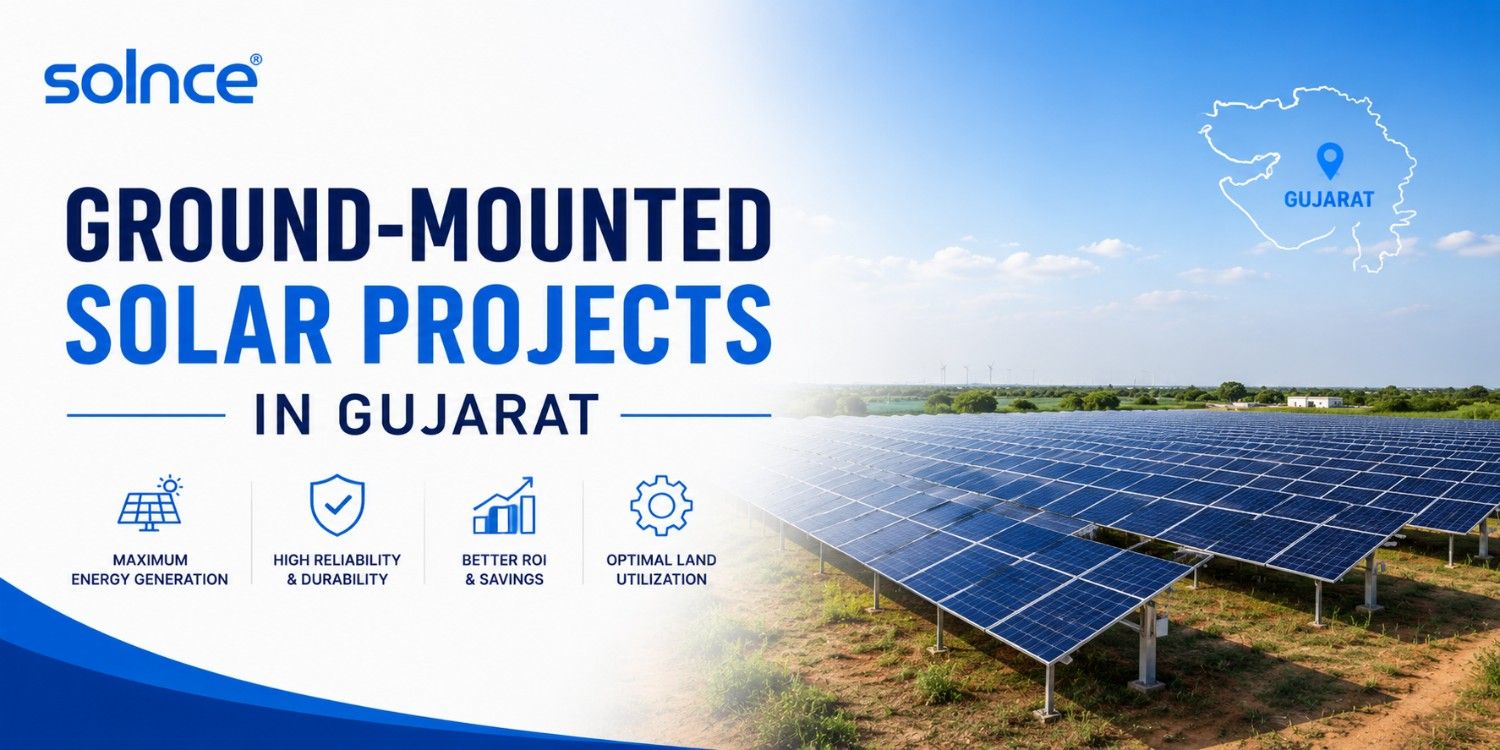
Ground-Mounted Solar Projects in Gujarat 2026: Process, Approvals, Timelines & Business Models
Last updated at : Jun 25, 2026
Gujarat is India's most advantaged state forutility-scale and C&I ground-mounted solar: 5.0–5.5 kWh/m²/day average solar irradiance, the most mature renewable energy policy framework via GEDA, dense industrial demand at ₹7–₹11/unit DISCOM tariffs, and well-laid transmission infrastructure. But the regulatory complexity is real — a 1 MW project touches six government authorities and runs through 17 stages, with the critical-path approvals (GETCO bay allocation, CEIG energisation clearance) determining whether you commission in month 6 or month 12. This guide is the complete commercial-buyer view.
1. Why Gujarat Leads India for Ground-Mounted Solar
• **Solar resource: **5.0–5.5 kWh/m²/day GHI — translating to 1,600–1,800kWh/kWp annual yield, 10–15% above southern and eastern states.
• **Policy maturity: **GEDA (established 1979) is India's oldest and most operationally mature state RE agency; the GERC open access and banking framework is the most developer-friendly in the country.
• **Industrial demand: **Among India's densest C&I bases (petrochemicals, textiles, ceramics, pharma, auto components) with DISCOM tariffs of₹7–₹11/unit, creating abundant offtake demand.
2. The Seven Business Models — At a Glance
The commercial model has to be decided before any land or grid work, because it determines every downstream approval, the equity structure, the tariff lock, and crucially whether Cross Subsidy Surcharge (CSS) applies.
| Model | Structure & Ownership | CSS | Timeline | Best For |
|---|---|---|---|---|
| Captive (Off-Site) | Single owner consumes 100% of generation; Open Access wheeling. | Exempt ✔ | 180–210 Days | Single large factory |
| Group Captive | SPV (Pvt Ltd) owns plant; each user holds ≥26% equity and consumes ≥51% of share. | Exempt ✔ | 180–200 Days | Multiple C&I users |
| 3rd-Party PPA (OA) | Developer owns the plant and sells power to C&I customers through a 15–25 year PPA. | CSS Applies | 200–240 Days | Zero-CAPEX C&I |
| PM-KUSUM-A | 500 kW–2 MW at 11/33 kV feeder; 25-year PPA through reverse bidding. | NA | 240–300 Days | Mid-scale developers |
| PM-KUSUM-B | Standalone solar pumps (≤7.5 HP); 30% Central + 30% State subsidy. | NA | 90–150 Days | Farmer pump deployments |
| PM-KUSUM-C | Solarisation of existing agricultural pumps — Individual or Feeder-Level. | NA | 180–240 Days | DISCOMs & Developers |
| DREBP | GUVNL Distributed RE Bidding — 10–50 MW at DISCOM substations. | NA | 210–270 days | Utility-scale IPPs |
Captive vs PPA — The Economic Divide:
Captive and Group Captive projects are CSS-exempt, while Third-Party PPAs pay CSS of approximately ₹0.50–₹1.50 per unit in Gujarat. For commercial and industrial (C&I) consumers who can commit at least 26% equity, Group Captive is almost always the most cost-effective long-term tariff option.
The 26%/51% rule comes from Section 9 of the Electricity Act, 2003 and Rule 3 of the Electricity Rules, 2005, with compliance verified annually by the statutory auditor.
3. The 17-Stage Process — Complete Overview
Every ground-mounted project moves through the same 17 stages, regardless of business model. What changes is the depth of each stage and the absolute time required.
| # | Stage | Duration | Key Authorities / Artefacts |
|---|---|---|---|
| 1 | Project Planning, Feasibility & Business Case | 1–2 Weeks | Internal Team / Consultants |
| 2 | Land Identification, Title Verification & NA Conversion | 2–6 Weeks | Revenue Department, Collector, Gram Panchayat |
| 3 | Grid Connectivity Feasibility & Substation Survey | 2–4 Weeks | GETCO / DISCOM |
| 4 | GEDA Registration on Gujarat RE Portal | 1–2 Weeks | GEDA |
| 5 | Connectivity Approval & Feasibility Study | 1–3 Months | GETCO + DISCOM |
| 6 | PPA / Captive / Open Access Approval | 3–6 Weeks | GUVNL / DISCOM / GERC |
| 7 | Detailed Engineering Design (Electrical, Civil & Mechanical) | 3–5 Weeks | EPC Engineering Team |
| 8 | CEIG Drawing & Protection Approval | 2–6 Weeks | CEIG Gujarat |
| 9 | Procurement of Modules, Inverters & Balance of System (BoS) | 4–8 Weeks (Overlapped) | Procurement Team |
| 10 | Civil Construction – Levelling, Fencing & Foundations | 4–10 Weeks | Civil Contractor |
| 11 | Electrical Installation – DC, AC, Transformer & HT Yard | 3–6 Weeks | Electrical Contractor |
| 12 | Pre-Commissioning Testing | 1–2 Weeks | Internal Team + TPI (DNV/TÜV) |
| 13 | CEIG Final Inspection & Energisation Approval | 1–3 Weeks | CEIG |
| 14 | DISCOM / GETCO Synchronisation Approval | 1–3 Weeks | DISCOM + SLDC |
| 15 | Plant Commissioning & COD Declaration | 1 Week | Project Director + DISCOM |
| 16 | Power Export, Billing & Banking Adjustment | Ongoing | Finance Team + DISCOM |
| 17 | O&M, Generation Monitoring & Annual Captive Verification | Ongoing | O&M Team + Statutory Auditor |
4. The 200-Day Reality — Month-by-Month View
Solnce's standard execution baseline for a Group Captive ground-mounted project in Gujarat is 180 to 200 days from kickoff to Commercial Operation Date:
| Month | Day Window | Activities |
|---|---|---|
| Month 1 | Days 0–30 | GEDA registration, land due diligence, NA conversion, DISCOM feasibility, SPV incorporation and Shareholder Agreement. |
| Month 2 | Days 30–60 | Connectivity approval, GETCO interconnection, EPC contract, equity infusion, term loan sanction and engineering design. |
| Month 3 | Days 60–90 | CEIG drawing approval, procurement purchase orders (POs), civil mobilisation, switchyard foundation and MMS piling. |
| Month 4 | Days 90–120 | MMS erection, module installation, inverter installation, DC/AC cabling, transformer foundation and lightning arrestor (LA) towers. |
| Month 5 | Days 120–155 | Transformer installation, HT yard, transmission line, GETCO bay, SCADA setup and pre-commissioning checks. |
| Month 6 | Days 155–200 | CEIG final inspection, DISCOM/GETCO joint inspection, grid synchronisation, performance ratio (PR) test, snag rectification, COD declaration and final project closeout. |
5. Critical Gujarat Authorities
| Authority | Full Name | Role |
|---|---|---|
| GEDA | Gujarat Energy Development Agency | Provisional registration, renewable energy approvals, project tracking, nodal agency for PM-KUSUM and state renewable energy schemes. |
| GUVNL | Gujarat Urja Vikas Nigam Ltd. | Utility PPA execution, DREBP tendering and centralised power purchase. |
| GETCO | Gujarat Energy Transmission Corporation | Transmission grid connectivity (66/132/220 kV) and bay allocation. |
| DGVCL | Dakshin Gujarat Vij Co. Ltd. | DISCOM for South Gujarat (Surat, Bharuch, Valsad and Navsari). |
| MGVCL | Madhya Gujarat Vij Co. Ltd. | DISCOM for Central Gujarat (Vadodara, Anand, Kheda and Panchmahal). |
| PGVCL | Paschim Gujarat Vij Co. Ltd. | DISCOM for West Gujarat (Rajkot, Jamnagar, Junagadh, Kutch and Morbi). |
| UGVCL | Uttar Gujarat Vij Co. Ltd. | DISCOM for North Gujarat (Ahmedabad, Mehsana, Banaskantha and Gandhinagar). |
| CEIG | Chief Electrical Inspector to Government | Drawing approval, electrical safety inspection and energisation clearance for HT systems. |
| GERC | Gujarat Electricity Regulatory Commission | Tariff determination, wheeling regulations, banking regulations, open access framework and CSS policies. |
| SLDC | State Load Despatch Centre | Grid dispatch, scheduling, forecasting, generator code compliance and power scheduling. |
6. Payment Milestones — Standard EPC Cashflow
| % | Stage | Trigger |
|---|---|---|
| 10% | Advance | EPC contract signing / Purchase Order (PO) issuance against Performance Bank Guarantee (PBG). |
| 60% | Materials | Pro-rata payment on dispatch of modules, inverters, MMS and transformers. |
| 20% | Installation | Released after completion of mechanical and electrical erection. |
| 10% | Commissioning | Payable on Commercial Operation Date (COD) after SLDC synchronisation and meter sealing. |
| 5% | DLP Retention | Released against PBG after completion of the 12-month Defect Liability Period (DLP). |
Other typical financial obligations: Performance Bank Guarantee (PBG) of 5% of contract; term loan from REC/IREDA/banks at 8.5–10.5% p.a. for 70% debt over 12–15 years; insurance (CAR + EAR + Marine + Liability) at ~0.5–1% of project cost annually during construction. A 1 MW project costs roughly ₹4.0–₹4.5 crore in 2026; a 10 MW project ₹38–₹42 crore.
7. Six Critical Challenges in Gujarat Projects
• Grid evacuation unavailable: Get written GETCO/DISCOM capacity confirmation before any land commitment.
• NA conversion delays: Section 65 conversion takes 4–8 weeks; engage a Gujarat-experienced revenue consultant from day one.
• CEIG documentation errors: Use a CEIG-empanelled design consultant for first submission; pre-walk drawings with the inspector.
• Open access approval delays: Initiate OA application in parallel with CEIG approval, not afterwards.
• Transmission line readiness: Start RoW acquisition and pole material procurement in month 3, not month 5.
• Wrong protection scheme: Independent relay coordination study before CEIG submission prevents rejection cycles.
8. Real Scenario — 5 MW Group Captive in Mehsana
Buyers: Three industrial consumers in UGVCL service area — an automotive ancillary in Mehsana (51% offtake, ₹9.20/unit current HT tariff), textile processing in Kalol (28%), ceramics in Patan (21%). Combined demand: 2,200 kVA. Monthly combined consumption: 9.2 lakh units.
Project: 5 MW DC on 22 acres of NA-converted land, 6.5 km from a 66 kV GETCO substation. TOPCon 580W modules, Sungrow string inverters, single-axis trackers, 33 kV step-up transformer, 66 kV transmission line.
Economics: Total project cost ₹19.5 crore. Term loan 70% from REC @ 9.25%, 15-year tenure. Year-one generation 8.5 million units. Levelised tariff to shareholders: ₹4.10/unit versus ₹9.20/unit grid. Annual savings: ₹4.3 crore. Post-tax IRR: 16.4%. Equity payback: 5.8 years. Total execution: 198 days kickoff to FCC.
Frequently Asked Questions (20)
1. What is the typical timeline for a ground-mounted solar project in Gujarat?
A ground-mounted solar project in Gujarat takes 180 to 300 days from kickoff to Commercial Operation Date (COD), depending on the business model. Group Captive runs 180–200 days, off-site Captive 180–210 days, Third-Party PPA 200–240 days, PM-KUSUM-A 240–300 days, and DREBP 210–270 days. Larger projects (>10 MW) add another 30–60 days for transmission line and substation bay readiness.
2. How much land is needed for a 1 MW ground-mounted solar plant in Gujarat?
A 1 MW ground-mounted solar plant in Gujarat needs approximately 4 to 5 acres of land — roughly 1 acre per 0.5 MWp DC under typical fixed-tilt configurations using 540–600W TOPCon modules. Single-axis trackers can compress the footprint by 15–20%. Topography, shadow obstruction, approach roads and module efficiency all affect the actual requirement.
3. What is the difference between Captive, Group Captive and PPA solar projects?
Captive: a single owner consumes 100% of the generation, uses Open Access for wheeling. Group Captive: an SPV (Pvt Ltd) owns the plant; each consumer holds ≥26% equity and consumes ≥51% of their share. Both are exempt from Cross Subsidy Surcharge (CSS). Third-Party PPA: a developer owns the plant and sells to a C&I customer via 15–25 year PPA; the customer pays generator tariff + wheeling + CSS + banking + losses. Group Captive is typically the most economical for multiple C&I consumers.
4. What is the 26% / 51% captive rule in India?
Per Section 9 of the Electricity Act 2003 and Rule 3 of the Electricity Rules 2005, a generating plant qualifies as captive only if each captive user holds at least 26% of the equity in the SPV and consumes at least 51% of the electricity generated proportional to their equity share. Both conditions must be met every year — verified by the statutory auditor and certified by CEIG in Form-1. Failure triggers retrospective CSS liability.
5. What approvals are required for ground-mounted solar in Gujarat?
Major approvals include: GEDA project registration; DISCOM (DGVCL/MGVCL/PGVCL/UGVCL) connectivity approval; GETCO interconnectivity approval (for ≥66 kV); CEIG drawing approval and final energisation clearance; Open Access registration with GERC (for Captive/GC/PPA); Wheeling Agreement and Banking Agreement with DISCOM; SLDC scheduling/forecasting code registration; Gram Panchayat NOC; NA conversion (for agricultural land); and Forest/Environmental clearance (if applicable).
6. What is GEDA and what is its role in solar projects in Gujarat?
GEDA (Gujarat Energy Development Agency), established in 1979, is the state nodal agency for renewable energy in Gujarat. It handles provisional registration of all renewable energy projects through the Gujarat RE Portal, project tracking, and coordination of state and central renewable schemes including PM-KUSUM. GEDA registration is the first formal regulatory step for any ground-mounted solar project in the state.
7. What is the role of GETCO in Gujarat ground-mounted solar?
GETCO (Gujarat Energy Transmission Corporation) handles transmission-level grid connectivity in Gujarat at 66 kV, 132 kV and 220 kV. For any ground-mounted solar plant connecting at these voltages (typically projects of 5 MW and above), GETCO interconnectivity approval and substation bay allocation is mandatory. Bay charges are payable, and GETCO substation readiness is often the critical-path item in the project schedule.
8. What is CEIG approval and is it mandatory for ground-mounted solar?
Yes, CEIG (Chief Electrical Inspector to Government, Gujarat) approval is mandatory for ground-mounted solar projects. CEIG approves both the plant design (drawing approval) and the final energisation (inspection clearance). Required documents include SLD, protection scheme, relay settings, earthing design, equipment datasheets, contractor electrical licence, and test certificates. CEIG drawing approval typically takes 2–6 weeks; final energisation inspection takes 1–3 weeks. CEIG documentation errors are one of the top three causes of project delay.
9. What is NA (non-agricultural) conversion in Gujarat and is it required for solar?
NA conversion under Section 65 of the Gujarat Land Revenue Code converts agricultural land for non-agricultural use. It is mandatory before a ground-mounted solar project can be built on agricultural land — without NA conversion, no construction can be legally undertaken. The process involves applying to the District Collector and typically takes 4–8 weeks. It is the single most common cause of project delay in Gujarat. Land already classified industrial or NA does not require this step.
10. What is the typical CAPEX for a 1 MW ground-mounted solar plant in Gujarat?
A 1 MW ground-mounted solar plant in Gujarat typically costs ₹4.0–₹4.5 crore in 2026 (₹40–₹45 per Wp DC), including modules, inverters, transformer, mounting structure, civil works, balance-of-system, transmission line (up to 5 km), CEIG and other approvals. Larger projects benefit from economies of scale — a 10 MW project costs ₹38–₹42 crore (₹38–₹42 per Wp). Costs exclude land acquisition and developer margin.
11. What loan rates and tenures are available for solar projects in Gujarat?
Term loans for ground-mounted solar projects in Gujarat are available from REC, IREDA, SBI, Canara Bank and other PSU banks at 8.5–10.5% per annum, with tenures of 12–15 years and typical debt-equity ratio of 70:30. Loan processing fee is approximately 1% of sanctioned amount. Banks require a comprehensive Detailed Project Report (DPR) with PVSyst yield report, PPA / Captive Agreement, and clear land title documents for sanction.
12. What is Open Access in solar and how does it work in Gujarat?
Open Access is the regulatory mechanism that allows a captive or PPA generator to wheel electricity through DISCOM transmission and distribution network to its consumer at a regulated wheeling charge. In Gujarat, Open Access is governed by GERC's Open Access Regulations. Long-Term (>5 years), Medium-Term (1–5 years), and Short-Term (<1 year) categories are available. Registration with GERC and a Wheeling Agreement with the relevant DISCOM are mandatory.
13. What is the difference between PM-KUSUM A, B and C schemes?
PM-KUSUM-A: decentralised solar plants of 500 kW–2 MW connected at 11/33 kV DISCOM feeders, selling to DISCOM under 25-year PPA at tariffs discovered via reverse bidding, with ~30% Central Financial Assistance. PM-KUSUM-B: individual standalone solar pumps (up to 7.5 HP) for farmers — no grid connection, with 30% Central + 30% State subsidy. PM-KUSUM-C: solarisation of existing grid-connected agricultural pumps, in two modes — Individual Pump Solarisation (IPS) at the pumpset, or Feeder-Level Solarisation (FLS) at the feeder.
14. What is DREBP and who can participate?
DREBP (Distributed Renewable Energy Bidding Programme) is GUVNL's flagship state programme for procuring solar capacity at DISCOM-level substations through reverse-bid tenders. Project sizes typically range 10–50 MW. Successful bidders sign a 25-year PPA with GUVNL. Eligible participants are independent power producers (IPPs) meeting net-worth, turnover and prior experience criteria specified in each tender. DREBP is currently one of the largest distributed solar opportunities in India.
15. What is the typical payment milestone structure for an EPC solar contract?
The standard EPC payment structure for ground-mounted solar in India follows a 10-60-20-10-5 ladder: 10% advance on contract signing against Performance Bank Guarantee (PBG); 60% on materials milestone (pro-rata on dispatch and delivery); 20% on installation milestone (mechanical and electrical erection complete); 10% on commissioning milestone (COD declared); and 5% retention released against PBG after the 12-month Defect Liability Period (DLP).
16. What is SLDC and why does it matter for ground-mounted solar?
SLDC (State Load Despatch Centre) in Gujarat handles real-time grid dispatch, scheduling and forecasting. Every ground-mounted solar project of 1 MW and above must register with SLDC, receive a unique generator code, and comply with day-ahead scheduling and forecasting requirements per the Indian Electricity Grid Code (IEGC) and the State Grid Code. Failure to comply triggers Deviation Settlement Mechanism (DSM) penalties.
17. Can agricultural land be used for ground-mounted solar in Gujarat?
Yes, but only after NA (non-agricultural) conversion under Section 65 of the Gujarat Land Revenue Code. The conversion process is filed with the District Collector and typically takes 4–8 weeks. After conversion, mutation must be done to update the 7/12 record. Land already classified as industrial, commercial or NA does not require this conversion. Some categories of agricultural land near forests, water bodies or restricted zones may not be eligible for NA conversion at all.
18. What is the banking arrangement for solar projects in Gujarat?
Under GERC's Banking Regulations, generators can 'bank' surplus solar energy with the DISCOM during high-generation periods and draw it back during low-generation periods, subject to a 1.5–2% banking loss as deemed by GERC. Banking is permitted for Captive, Group Captive and Open Access projects, governed by a Banking Agreement signed with the DISCOM. Annual settlement applies, and any unutilised banked energy at year-end is typically purchased by the DISCOM at the Average Pooled Power Purchase Cost (APPC).
19. How is the wheeling charge calculated in Gujarat for solar?
Wheeling charges in Gujarat are determined by GERC under the Wheeling Regulations and notified periodically (typically annual revisions). The charge applies per unit of electricity wheeled through the transmission and distribution network to the consumer's premises, and varies by voltage level of injection and drawal. As of 2026, wheeling charges in Gujarat are among the most competitive in India — one of the reasons Gujarat is the preferred state for C&I open access solar.
20. What insurance is required for a ground-mounted solar project?
Comprehensive solar project insurance typically includes four covers: Construction All Risks (CAR) — for the construction phase, covering material damage and civil works; Erection All Risks (EAR) — for equipment erection; Marine cover — for transit of major equipment; and Public Liability insurance. Many lenders mandate Business Interruption (BI) and Loss of Profit cover post-COD. Total insurance premium typically runs 0.5–1% of project cost annually during construction, and 0.2–0.3% during operations.
Planning a Ground-Mounted Solar Project in Gujarat?
Solnce Energy delivers turnkey ground-mounted solar projects — feasibility study, approvals, EPC, testing, synchronization, and commissioning. We support Captive, Group Captive, Third-Party PPA, PM-KUSUM, and DREBP projects across Gujarat with a standard execution timeline of approximately 180 days.