Net Metering vs Net Billing vs Gross Metering
Last updated at : Aug 19, 2026
Two identical rooftop systems, one in Jaipur and one in Chennai, will earn their owners very different amounts of money. Not because of the panels. Because of the metering regime the state regulator chose.
This is the single largest variable in Indian rooftop solar economics, and it is also the one buyers understand least. Most solar quotes model savings as units generated × your tariff. That calculation is correct only under net metering. Under net billing it overstates your return, sometimes badly. Under gross metering it is simply the wrong equation.
Below is what each mechanism actually does, followed by a state-by-state table for the twelve states Solnce operates in — with the governing regulation, its date, and a plain note where the position is genuinely unsettled.
The three mechanisms, in plain terms
Net metering — you trade units for units
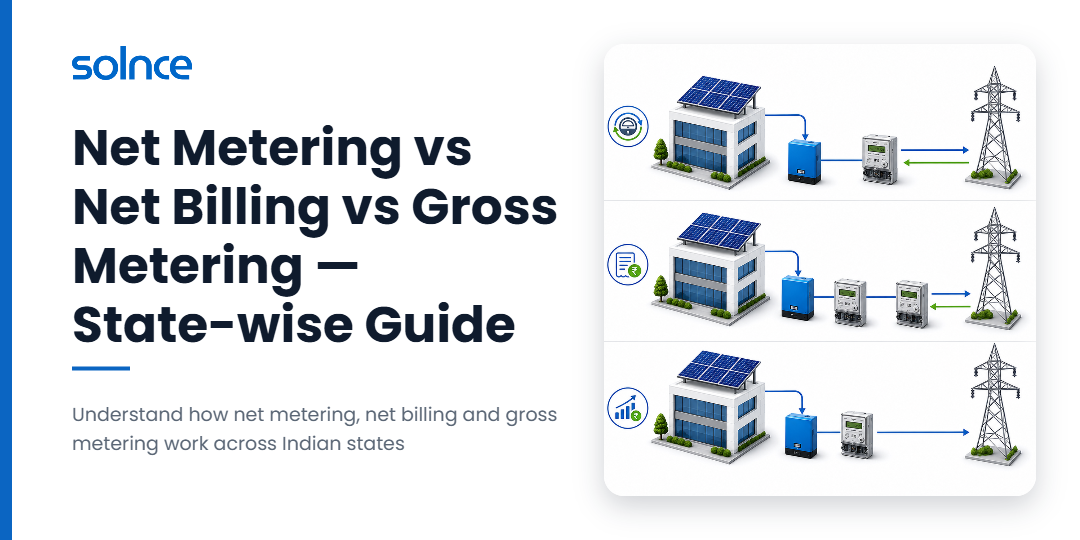
A bi-directional meter records what you import from the grid and what you export to it. At the end of the billing period the two are netted, and you pay only for the difference. A unit you export today offsets a unit you import tonight, one for one.
This is the most valuable arrangement for the consumer, because every exported unit is effectively worth your full retail tariff. It is also the arrangement DISCOMs like least, which is why almost every state has been narrowing it.
Best for: homes and small commercial consumers whose consumption roughly matches their generation over a billing cycle.
Net billing — you trade units for money, at two different prices
You still have a bi-directional meter, but the netting is monetary rather than unit-for-unit. You buy imported units at your retail tariff and sell exported units at a separate, regulator-fixed export rate — which is almost always lower.
The gap between those two prices is the whole story. In Rajasthan the net billing export rate is ₹3.65 per unit. If your retail tariff is ₹8, every unit you export instead of self-consuming loses you ₹4.35. Under net billing, self-consumption is dramatically more valuable than export, which changes how a system should be sized and when loads should run.
Best for: consumers who can shift daytime load to match generation, and larger systems that have outgrown the net metering cap.
Gross metering — you sell everything and buy everything back
The entire output of your plant goes to the grid through a dedicated meter, at a fixed feed-in tariff. Your consumption is billed separately at full retail tariff. There is no netting at all; you are running a small generating business alongside being a consumer.
Best for: consumers whose consumption pattern doesn’t align with generation, or where the feed-in tariff is attractive relative to a low retail tariff.
And two variants worth knowing
Group net metering (GNM) lets one consumer offset generation from a system at one property against bills at their other connections — useful for a business with several premises, or a homeowner with a farmhouse.
Virtual net metering (VNM) lets multiple consumers share the output of a single system they don’t individually own, allocated by a pre-agreed ratio. It is the answer for apartment residents with no roof of their own and for housing societies. Gujarat, Rajasthan, Delhi, Punjab, Karnataka, Telangana and Madhya Pradesh have all introduced some form of it.
The national baseline
The Electricity (Rights of Consumers) Rules, 2020 are the central overlay. Rule 11(4), as amended by the 2021 amendment rules, provides that where state regulations are silent, the Commission may allow net metering up to 500 kW or the sanctioned load, whichever is lower, with other arrangements above that.
Two things follow. First, this is a floor and a default, not a ceiling — several states permit far more. Second, the operative rules are almost always the state regulations, which is why a national answer to “what is the net metering limit in India” does not exist.
Rule 11(12) is worth knowing separately: where a distribution licensee delays without just cause, it is liable to compensate the consumer at not less than ₹500 per day of default.
One caution. A draft Electricity (Rights of Consumers) Amendment Rules, 2026 was issued on 12 March 2026 proposing, among other things, a net-metering charge on systems above 5 kW and mandatory storage above 500 kW. As at the date of this article it remains a draft and has not been notified. Treat any content presenting it as current law with suspicion.
The state-by-state table
All entries verified against the cited regulation or a named report. Where a figure could not be verified, the cell says so rather than estimating.
| State | Regime Available | Residential Cap | C&I Cap | Export Rate | Settlement | DT Loading Cap | Governing Regulation |
|---|---|---|---|---|---|---|---|
| Gujarat | Net metering | No sanctioned-load restriction for residential; 1 MW ceiling | 50% of sanctioned load, 1 MW ceiling | APPC of the year of commissioning, locked for the life of the system | Within one billing cycle | 65% | GERC Notification 5/2016 dated 18.06.2016; Fifth Amendment effective 4 Nov 2025 |
| Maharashtra | Net metering and net billing; VNM | Sanctioned load / contract demand | Same; the 1 MW cap does not apply under net billing | ₹2.82/kWh for FY 2026–27 (MERC order, 31 Mar 2026) | Annual, 1 Apr – 31 Mar | 70% | MERC (Grid Interactive Rooftop RE) Regulations, 2019, notified 30 Dec 2019 |
| Punjab | NM, net billing, gross; GNM and VNM added 2026 | 100% of sanctioned load, 500 kWp ceiling | 70% of sanctioned load, 500 kWp ceiling | 75% of the approved feed-in tariff | Annual, 1 Oct – 30 Sep | 80% | PSERC Regulations 2021 (18 Aug 2021); Third Amendment notified 7 Apr 2026, effective 1 July 2026 |
| Tamil Nadu | NM, net billing/feed-in, gross — but not to everyone | LT domestic: NM or net feed-in, up to sanctioned load | LT non-domestic: net feed-in ONLY, no net metering. HT 151–999 kW: all three | 2021 slabs ₹3.10–3.61/kWh expired 31 Mar 2023; current rate not verified | FY; net metering surplus lapses on 31 March | 90% | TNERC GISS Regulations, 2021 (sources give 7 Oct and 22 Oct 2021) |
| Uttar Pradesh | Net metering only for LMV-1 domestic and LMV-5 agricultural. All other categories: gross or net billing | 1 kWp–2 MWp, ≤100% of contracted demand | Same envelope, gross/net billing only | Gross: large-scale weighted average +25% incentive. Exit rate ₹2/kWh | Not defined in the regulations | 75% | UPERC Regulations 2019, notified 04.01.2019 |
| Telangana | NM, gross, GNM, VNM | 500 kW, ≤100% of sanctioned load | 500 kW, capped at 80% of contracted demand; gross to 1 MW | Lowest tariff discovered in the previous year’s bidding; locked 25 years | Monthly | 50% — the most restrictive in India | TGERC Rooftop Solar Regulation, 2025 (draft 14 Aug 2025) |
| Andhra Pradesh | NM and gross; VNM/GNM proposed | 500 kWp | 500 kWp | Not verified | Not verified | Not verified | APERC Regulation 4 of 2023; clarification June 2026 grandfathering pre-2023 projects of 500–1,000 kWp |
| Madhya Pradesh | NM, GNM, gross, VNM | 500 kW | NM 500 kW; gross to 1 MW | Lowest tariff discovered in the previous FY’s bidding | Annual, 1 Oct – 30 Sep, paid by 15 November | 70% | MPERC regulations — source titles conflict; draft First Amendment 15 May 2026 |
Four things this table tells you that a solar quote won’t
-
Tamil Nadu’s commercial consumers cannot get net metering at all. LT non-domestic consumers are restricted to net feed-in. This is the single most commonly mis-stated fact in Indian solar content, and it changes a Chennai shop’s payback materially. Tamil Nadu also levies network charges on units generated — ₹1.27/kWh for LT commercial, ₹0.254/kWh for domestic up to 10 kW — which no other state in this table does in the same form.
-
Uttar Pradesh is the same story, more severely. Net metering is available only to metered domestic and metered agricultural connections. Every commercial and industrial consumer in UP is on gross metering or net billing, whatever a quotation implies.
-
Your export rate may be locked for 25 years — or reset annually. Karnataka and Telangana lock the rate at commissioning for 25 years. Gujarat locks the APPC of the commissioning year for the system’s life. Maharashtra resets it every year by tariff order. If you are comparing two states, you are comparing two very different risk profiles.
-
Settlement dates are not uniform, and one state lets your credits expire. Maharashtra settles April–March, Punjab and Madhya Pradesh October–September, Telangana monthly, Gujarat within a single billing cycle. In Tamil Nadu, unadjusted net metering surplus lapses on 31 March — it is not carried forward and it is not paid. Sizing a Tamil Nadu system to over-generate is sizing it to give electricity away.
Where the rules changed in 2026
Five of the twelve states moved this year, and most published comparisons have not caught up:
-
**Delhi, 20 January 2026 **— the Seventh Amendment to the GNM/VNM Guidelines moved surplus credit from the off-peak time block to the normal block, a direct economic improvement, and extended eligibility to single-point-of-supply consumers.
-
**Punjab, effective 1 July 2026 **— group and virtual net metering introduced for the first time.
-
Andhra Pradesh, June 2026 — APERC clarified that Clause 22 of Regulation 4 of 2023 is a grandfathering provision: projects of 500–1,000 kWp commissioned before the regulation keep their existing terms.
-
Gujarat, draft dated 15 May 2026 — the GERC Grid Interactive DRES Regulations would replace the 2016 regime entirely, adding net billing, gross metering to 4 MW, virtual net metering to 4 MW, and a battery storage mandate for consumers above 100 kW contract demand who install beyond their contracted load.
-
Madhya Pradesh, draft 15 May 2026 — fee waivers for PM Surya Ghar applicants and the agreement folded into the online application form.
Kerala is the outlier and deserves its own warning. KSERC notified new Renewable Energy Regulations on 5 November 2025 which would have cut residential net metering eligibility to 3 kW and introduced a grid support charge. The Kerala High Court stayed their operation on 10 November 2025. The position after that has not been reliably reported. If you are being quoted for a Kerala rooftop system** **on the basis of either the old or the new regime, ask your installer to show you which regulation they are relying on.
How to use this before you sign anything
Ask your installer four questions, and get the answers in writing on the quotation:
-
Wich mechanism applies to my connection category, at my proposed system size? Not “net metering is available in my state” — the category and the size both matter.
-
What is the export rate, and is it locked? If locked, for how long. If not, when does it reset.
-
What is the settlement period, and what happens to unadjusted credits at the end of it?
-
Has my distribution transformer got headroom? A 50% cap in Telangana or 65% in Gujarat can make an otherwise feasible project infeasible, and it is discovered at feasibility stage, not at quotation stage.
If a savings projection has been built on units × retail tariff and you are in a net billing or gross metering state, the projection is wrong. Ask for it to be rebuilt.
Sources and verification
Every figure above traces to the regulation named in the table or to a named trade report of it. Where a cell reads “not verified,” we could not source it to a standard we would publish — we would rather show you the gap than fill it with an estimate.
This table is re-verified quarterly. Regulations in this space move constantly: five of these twelve states changed something in 2026 alone. The “last verified” date at the top of this page is the date to trust.
Last verified: 11 August 2026.
Frequently asked questions
**1. What is the difference between net metering and net billing in simple terms? **
Net metering nets units against units — one unit exported cancels one unit imported. Net billing nets money — you buy at your retail tariff and sell at a lower regulated export rate. Under net metering an exported unit is worth your full tariff; under net billing it is worth only the export rate, which is usually well below it.
**2. Which is better for a homeowner, net metering or net billing? **
Net metering, almost always, because it values your exported units at retail rather than at a discounted export rate. Where only net billing is available, the system should be sized and operated for maximum self-consumption rather than maximum generation.
**3. What is gross metering and when does it make sense? **
Your entire generation is sold to the DISCOM at a fixed feed-in tariff and your consumption is billed separately at retail. It makes sense where your consumption pattern doesn’t overlap with daytime generation, or where the feed-in tariff is high relative to a low retail tariff. In several states it is not a choice — it is what you get above a capacity threshold.
**4. What is the net metering capacity limit in India? **
There is no single national limit. The central rules set a default of 500 kW or your sanctioned load, whichever is lower, where the state is silent — but states set their own. Rajasthan and Gujarat permit up to 1 MW, Punjab and Telangana cap at 500 kW, and Uttar Pradesh permits up to 2 MWp but only for domestic and agricultural categories.
**5. Can commercial consumers get net metering in Tamil Nadu? **
LT non-domestic consumers cannot — they are limited to net feed-in. HT consumers between 151 kW and 999 kW may choose net metering, net billing or gross metering. This is a genuine restriction and it is frequently misrepresented.
**6. Can a business get net metering in Uttar Pradesh? **
Under the UPERC 2019 regulations, net metering is available only to LMV-1 (metered domestic) and LMV-5 (metered agricultural) consumers. Commercial and industrial consumers use gross metering or net billing.
**7. What is virtual net metering and who is it for? **
Virtual net metering allows several consumers to share the output of a single solar system they do not individually own, with credits allocated by a pre-agreed ratio. It is designed for apartment residents without their own roof, housing societies and community projects. Gujarat, Rajasthan, Delhi, Punjab, Karnataka, Telangana and Madhya Pradesh all provide for it in some form.
**8. What is group net metering? **
Group net metering lets a single consumer offset generation from a system at one property against consumption at their other connections — for example a business with several branches, or a household with a second property. Karnataka requires at least 20% of generation to be consumed at the generation site.
**9. What happens to my surplus units at the end of the settlement year? **
It depends entirely on the state. Maharashtra purchases unadjusted credits at the generic tariff. Punjab compensates at 75% of the feed-in tariff. Madhya Pradesh pays by 15 November. Tamil Nadu lets net metering surplus lapse on 31 March — unpaid and uncarried.
**10. Is my export rate fixed for the life of the system? **
In Karnataka and Telangana it is locked for 25 years from commissioning. In Gujarat the APPC of your commissioning year applies for the system’s life. In Rajasthan the rate is locked for the agreement term. In Maharashtra it is reset annually by tariff order. Ask your installer which applies and get it in writing.
**11. What is a distribution transformer loading cap and why should I care? **
Most states limit how much solar can be connected to a single distribution transformer — 50% in Telangana, 65% in Gujarat, 70% in Maharashtra and Madhya Pradesh, 75% in Uttar Pradesh, 80% in Punjab, 90% in Tamil Nadu. If your local transformer is already at the limit, your application can be rejected on technical feasibility regardless of your roof or your load.
**12. Does net metering require DISCOM approval? **
A net metering agreement and inspection are required everywhere. Feasibility approval is increasingly waived for small systems — under PM Surya Ghar, systems up to 10 kW are deemed approved without a separate feasibility study, and Delhi, Uttar Pradesh and Rajasthan have all introduced deemed-approval or fixed-timeline rules.
**13. Can the DISCOM refuse my net metering application? **
Yes, principally on technical feasibility — usually distribution transformer headroom, or a system size exceeding the permitted proportion of your sanctioned load. Several states now impose a deadline after which silence counts as approval; Delhi requires feasibility within 15 days or the application is deemed approved.
**14. Do I pay any charges on rooftop solar generation? **
In most states, no. Two exceptions matter. Tamil Nadu levies network charges on units generated. Maharashtra permits grid support charges on net-metered generation, with all consumers up to 10 kW sanctioned load exempt. Punjab and Rajasthan expressly exempt domestic rooftop solar from wheeling, banking and cross-subsidy charges.
**15. Is net metering the same for residential and commercial consumers? **
No, and this is where most confusion sits. Gujarat allows residential systems irrespective of sanctioned load but caps commercial at 50% of it. Punjab allows 100% of sanctioned load for residential and 70% for commercial. Telangana caps commercial at 80% of contracted demand. Tamil Nadu and Uttar Pradesh exclude most commercial consumers from net metering altogether.
**16. If I move to net billing, should I size my system differently? **
Yes. Under net billing, a unit you consume yourself is worth your full retail tariff while a unit you export is worth only the export rate. That argues for sizing closer to your daytime baseline load and shifting shiftable loads — water heating, pumping, EV charging — into daylight hours.
**17. Are these rules likely to change again? **
Yes. Five of these twelve states changed something in 2026, and a draft central amendment issued in March 2026 proposes further changes including a possible net-metering charge above 5 kW. Any comparison you read — including this one — needs a visible verification date. Ours is at the top of the page.
18. How do I find out which regime applies to my exact connection?
Check three things: your consumer category as printed on your electricity bill, your sanctioned load or contract demand, and your DISCOM. Those three together determine your regime under your state’s regulation. If you would like us to check it against your actual bill, send it to us and we will tell you — including if the answer makes solar a poor fit for you.