PM Surya Ghar Subsidy Status: Check Approval & Maximize Your Savings
Last updated at : Nov 27, 2026
If you applied for rooftop solar under PM Surya Ghar: Muft Bijli Yojana and have not checked your application in a while, check it this week. From 30 November 2026, the Ministry of New and Renewable Energy (MNRE) will start archiving applications that are stuck. An archived application loses its place in the queue. If you re-apply, it counts as a brand-new application.
At the same time, the clock is running out on the current phase. MNRE has said 31 March 2027 is the final date to finish installation and upload the installation details on the National Portal to qualify for Central Financial Assistance (CFA). The portal will not accept installation details from 1 April 2027.
This guide explains, in plain language, how to check your PM Surya Ghar subsidy status, what each stage means, what the new archiving rules say, and how to get the maximum subsidy and savings from your rooftop system before the deadline.
Quick summary. (1) Pick a vendor within 15 days of applying. (2) Finish installation within 45 days of picking a vendor. (3) Archiving rounds: 30 Nov, 10 Dec, 20 Dec and 30 Dec 2026, with no individual warning. (4) Finish everything before 31 March 2027. (5) Central subsidy is up to ₹78,000; Gujarat homes up to 2.18 kWp may also get a state top-up.
Where the scheme stands today
PM Surya Ghar was launched in February 2024 with a target of rooftop solar on 1 crore homes by 31 March 2027. As of late November 2026, MNRE reports more than 91 lakh applications on the National Portal (regular and ULA models together) and around 68 lakh consumers who have already benefited.
That gap between applications and installations is the reason for the new rules. Many applications were registered but never moved forward: no vendor was chosen, or the vendor never installed. MNRE says these inactive applications are blocking the pipeline, and it wants the total number of applications to stay within the 1 crore target.
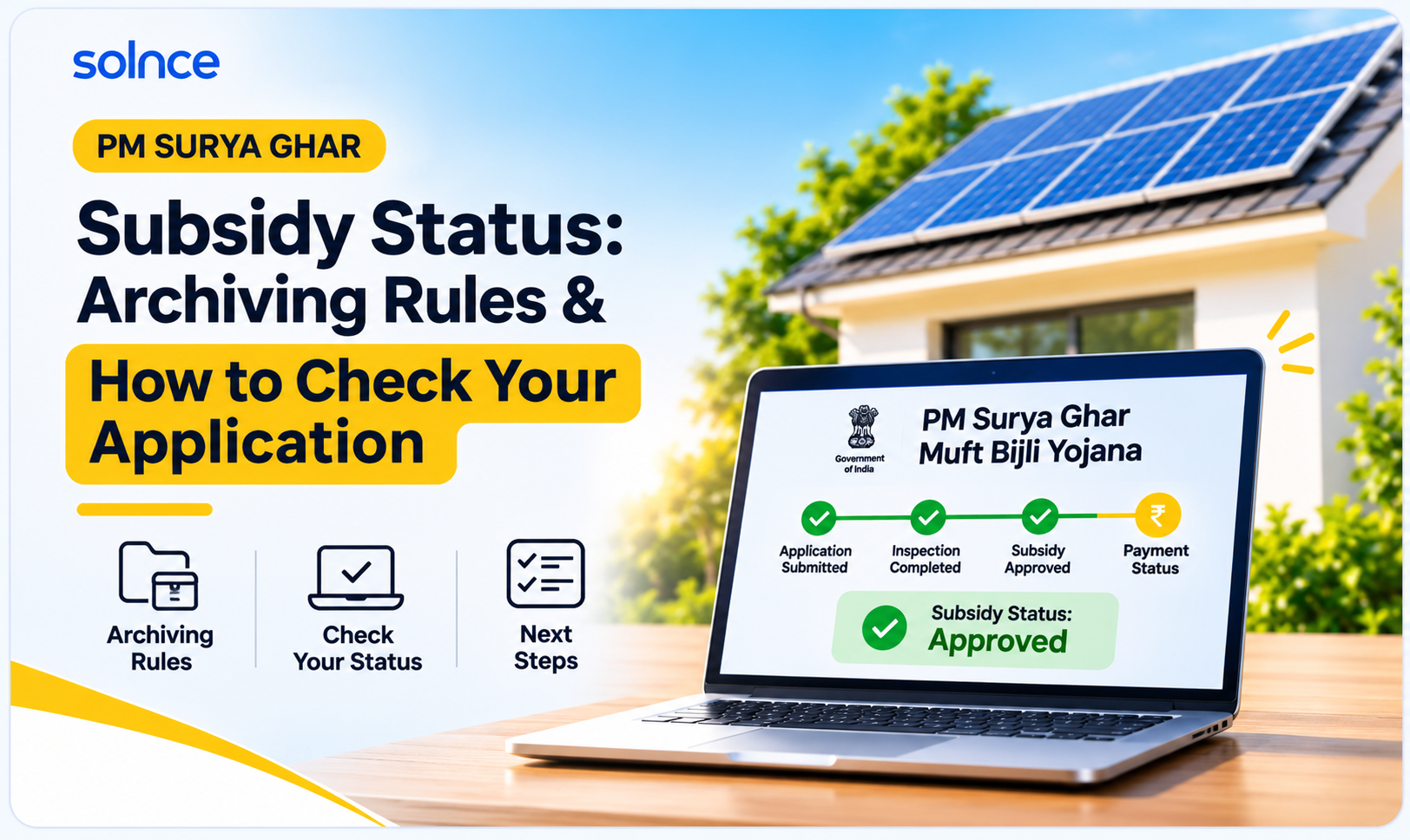
How to check your PM Surya Ghar subsidy status (step by step)
You can check your status yourself in about two minutes. Keep your registered mobile number handy.
- Go to the official National Portal: pmsuryaghar.gov.in. Do not use look-alike websites or links sent by unknown numbers.
- Click Login and choose consumer login. Enter your registered mobile number and the OTP you receive.
- Open your dashboard and go to My Applications (or Application Status). You will see your application number and its current stage.
- Check the date of each completed stage. Compare it with the 15-day and 45-day rules below.
- If installation is done, make sure the installation details are uploaded, your Subsidy Bank Details (with a cancelled cheque or passbook) are added, and the Redeem Subsidy checklist shows all items complete.
- After inspection and commissioning, the subsidy is released to the bank account you added. Watch for SMS updates and check the portal regularly.
What each stage means
| Stage on portal | What it means | What you should do |
|---|---|---|
| Registration / Application submitted | Your application is in the system | Select a vendor within 15 days, or the application may be archived. |
| Feasibility (DISCOM) | Your electricity company checks your connection and load | Respond quickly if DISCOM asks for documents |
| Vendor selected | You have chosen an empanelled vendor | Installation must be completed within 45 days from this date |
| Installation details uploaded | Vendor/you have uploaded system details and photos | Check panel, inverter and capacity details are correct |
| Net meter / Inspection | DISCOM installs the net meter and inspects the system. | Keep the site accessible; note the inspection date. |
| Commissioned | System is approved and working on-grid | Add subsidy bank details if not done yet |
| Redeem subsidy / CFA released | Subsidy claim is processed and paid to your bank. | If it stays pending for long, raise a grievance on the portal. |
Tip: Stage names can look slightly different on your screen as the portal is updated. What matters is the date you submitted, the date you selected a vendor and the date of installation.
The new archiving rules explained
On 24 November 2026, MNRE announced a phased archiving process for inactive applications. It comes into effect from 30 November 2026 and applies to applications under the non-ULA and non-bank-loan categories. National Programme Implementation Agency REC Limited will make the changes on the National Portal.
Which applications will be archived?
•No vendor in 15 days: applications where the consumer has not selected a vendor within 15 days of submitting the application. •No installation in 45 days: applications where rooftop solar installation has not been completed within 45 days from the date of vendor selection.
Archiving dates
| Round | Date | Based on |
|---|---|---|
| 1 | 30 November 2026 | Status on the National Portal on that date |
| 2 | 10 December 2026 | Updated portal status |
| 3 | 20 December 2026 | Updated portal status |
| 4 | 30 December 2026 | Updated portal status |
What happens if your application is archived
•MNRE has said no separate message will be sent to individual consumers or vendors before archiving. •You can submit a fresh application on the National Portal, but it is treated as new. Your original application date will not count for eligibility or processing. •Once the number of active applications reaches 1 crore (all categories), the portal will stop accepting new applications. New ones may be allowed only when space opens up after archiving. •MNRE may shorten these timelines further in future, including the time allowed between vendor selection and installation.
Bottom line: if you applied months ago and have not chosen a vendor, or your vendor has not installed, act before the next archiving date. Re-applying later is possible but not guaranteed, because the portal can close once it hits the 1 crore cap.
Rules for vendors (why this matters to you)
MNRE has told empanelled vendors to accept orders only from active applicants whose installation and portal submission can be completed before 31 March 2027. Earlier, in August 2026, MNRE deactivated 66 vendors over pending applications, and vendors were told not to hold applications for more than 60 days. For you, this means: choose a vendor that can give a clear installation date, and confirm the vendor is active and empanelled on the portal before you pay anything.
31 March 2027: the deadline that matters most
According to MNRE, 31 March 2027 is the final deadline to complete rooftop solar installation and submit the required installation details on the National Portal to qualify for CFA. The portal will not accept installation completion details from 1 April 2027.
Work backwards from that date. Feasibility, installation, net metering and inspection all take time, and the last few weeks before a deadline usually bring a rush. A sensible plan is to have your system installed and details uploaded by January–February 2027, leaving time for net meter and inspection.
What about Phase 2?
In November 2026, a senior MNRE official said a second phase of PM Surya Ghar is expected around March 2027. As of today, Phase 2 has not been officially notified, and its subsidy amounts, rules and start date are not known. Do not delay your installation on the hope of a future phase. The confirmed subsidy is the one available now, and only if you finish before 31 March 2027.
Older (pre-PM Surya Ghar) rooftop applications: separate from the archiving rules above, MNRE set 30 November 2026 as the last date for CFA claims under the earlier Rooftop Solar Programme Phase-II for applications already at the redeemed, inspected or installed stage (reported by Energetica India, September 2026). If you applied under the older programme, check with your DISCOM this week.
How much subsidy can you get?
Central subsidy (CFA) for homes
| System size | Central subsidy | How it is calculated |
|---|---|---|
| 1 kW | ₹30,000 | ₹30,000 per kW for the first 2 kW |
| 2 kW | ₹60,000 | ₹30,000 × 2 kW |
| 3 kW - 10 kW | ₹78,000 (maximum) | ₹60,000 + ₹18,000 for the 3rd kW; capped at 3 kW |
Group Housing Societies and Resident Welfare Associations (GHS/RWA) can get ₹18,000 per kW for common facilities, including EV charging, for up to 500 kW (at 3 kW per house).
Gujarat state top-up (for systems up to 2.18 kWp)
In October 2026, the Government of Gujarat approved an additional state subsidy for residential rooftop systems of up to 2.18 kWp under PM Surya Ghar. The household pays only 10% of the benchmark cost (5% for SC/ST households). The state covers what remains after the central subsidy and the household share. •Benchmark cost: ₹50,000 per kW for the first 2 kW and ₹45,000 per kW beyond that. •Who pays it: your DISCOM (DGVCL, MGVCL, PGVCL, UGVCL or Torrent Power) by Direct Benefit Transfer. GUVNL is the nodal agency. •Eligibility: only systems commissioned on or after 22 October 2026, with installed DC capacity not above 2.18 kWp. •Lock-in: if you take the state top-up, you cannot add more rooftop capacity for 3 years from installation.
Example for a 2 kW home in Gujarat (benchmark basis): benchmark cost ₹1,00,000 → central subsidy ₹60,000 → household share 10% = ₹10,000 → state top-up ₹30,000. For a 2.18 kWp system, the benchmark works out to ₹1,08,100, the household share to about ₹10,810 and the state top-up to about ₹34,050. These are benchmark figures. Ask your vendor how their actual quote compares with the benchmark before you sign.
Bigger home, bigger bill? If your monthly use is high, a 3 kW system gets the full ₹78,000 central subsidy but will not qualify for the Gujarat top-up (limit 2.18 kWp). Compare both options against your bill, not just the subsidy.
Bank loans
The scheme also offers collateral-free, concessional bank loans for residential systems up to 3 kW through public sector banks. The rate is linked to the RBI repo rate, so it changes over time; confirm the current rate and paperwork with your bank. Note that MNRE’s archiving announcement applies to the non-bank-loan category, so bank-loan applications follow their own process. Ask your bank and vendor how long your loan sanction will take, because the 31 March 2027 deadline still applies.
How to maximise your savings (not just your subsidy)
The subsidy is a one-time benefit. The real value of rooftop solar is the lower electricity bill every month for the next 25 years.
Here is how to get the most out of it.
1. Size the system to your bill
Look at your last 12 months of bills, not just one summer month. In Gujarat, 1 kW of rooftop solar typically produces around 4 units a day on average (about 120 units a month), depending on season, shade and panel angle. If you use about 300 units a month, a 3 kW system is usually the right range. Oversizing beyond your use does not always pay, because surplus export rates are often lower than what you pay per unit.
2. Use net metering properly
Your on-grid system exports extra daytime power to the DISCOM through a net meter and draws power at night. Make sure the net meter is installed and commissioned, and read your first two net-metered bills carefully to confirm imports and exports are recorded correctly.
3. Choose the right panels and vendor
•Use DCR (domestic content) panels from the ALMM list, as required for the central subsidy. •Choose an empanelled, active vendor with a written installation date inside the 45-day window. •Ask for the warranty terms in writing: panel performance warranty, inverter warranty and workmanship warranty.
4. Get the roof and shade right
A south-facing, shade-free roof gives the best output. Check for shade from water tanks, nearby buildings and trees at different times of the day. Even partial shade on one panel can reduce the output of a whole string.
5. Keep it clean and monitored
Dust is the biggest everyday loss in Gujarat. Clean the panels with plain water every 1–2 weeks in dry months, early morning or evening. Use the inverter app or a monitoring app to spot sudden drops in generation, which can point to a fault.
6. Keep your documents in one place
Save your application number, vendor agreement, invoice, installation photos, net meter papers, commissioning certificate and bank details. If your subsidy is delayed, these papers make the grievance process much faster.
Your 7-day action checklist
1.Log in to pmsuryaghar.gov.in and note your current stage and dates. 2. If no vendor yet: select an empanelled vendor now (15-day rule). 3. If vendor selected: ask for a written installation date within 45 days. 4. If installed: confirm installation details, bank details and redeem checklist are complete. 5. Gujarat homes up to 2.18 kWp: ask your vendor and DISCOM about the state top-up. 6. Plan to finish installation by January–February 2027 to avoid the March rush. 7. Save all documents and screenshots of each stage.
Frequently asked questions
Q1. How do I check my PM Surya Ghar subsidy status? Log in at pmsuryaghar.gov.in with your registered mobile number and OTP, then open My Applications. You will see your current stage, from application to subsidy release.
Q2. What is the last date for PM Surya Ghar? MNRE has set 31 March 2027 as the final date to complete installation and upload installation details for CFA. The portal will not accept installation details from 1 April 2027.
Q3. Why will my application be archived? If you have not selected a vendor within 15 days of applying, or installation is not completed within 45 days of selecting a vendor. This applies to non-ULA and non-bank-loan applications.
Q4. When are the archiving dates? 30 November 2026, then 10, 20 and 30 December 2026, based on the status on the portal on those dates.
Q5. Will I get a message before my application is archived? No. MNRE has said no separate communication will be sent before archiving. Check your status yourself.
Q6. Can I apply again after archiving? Yes, you can submit a fresh application, but it is treated as new and your original application date will not be counted.
Q7. Can the portal stop taking new applications? Yes. Once active applications reach 1 crore, the portal will stop accepting new ones. New applications may be allowed periodically as space opens up after archiving.
Q8. How much subsidy will I get for 3 kW? ₹78,000 is the maximum central subsidy for homes: ₹30,000 per kW for the first 2 kW and ₹18,000 for the 3rd kW. Systems above 3 kW still get ₹78,000.
Q9. Is there an extra Gujarat subsidy? Yes, for residential systems up to 2.18 kWp commissioned on or after 22 October 2026. The household pays 10% of the benchmark cost (5% for SC/ST), and the state covers the rest after the central subsidy.
Q10. If I take the Gujarat top-up, can I add more panels later? Not for 3 years from the installation date, as per the state notification.
Q11. Is Phase 2 of PM Surya Ghar confirmed? Not yet. An MNRE official has said a second phase is expected around March 2027, but it has not been officially notified. Its rules and subsidy are not known.
Q12. How long does the subsidy take to reach my bank account? It is released after inspection, commissioning and a complete redeem-subsidy claim. Timelines vary by state and DISCOM. If it stays pending for a long time, raise a grievance on the portal.
Q13. Which documents do I need for the subsidy? Typically your latest electricity bill and consumer number, ID proof, bank details with a cancelled cheque or passbook, installation photos and the commissioning or net-meter papers.
Q14. Do I need special panels to get the subsidy? Yes. The central subsidy requires domestically manufactured (DCR) panels from the approved ALMM list. Ask your vendor to show this on the invoice.
Q15. Does the archiving rule apply to bank-loan applications? MNRE’s announcement covers the non-ULA and non-bank-loan categories. Bank-loan applicants should still complete installation before 31 March 2027.
Q16. Can a housing society apply? Yes. GHS/RWAs can get ₹18,000 per kW for common facilities, including EV charging, up to 500 kW (at 3 kW per house).
Q17. What size system should I choose? Base it on your 12-month average bill. As a rough guide in Gujarat, 1 kW gives about 120 units a month. A home using about 300 units a month usually needs about 3 kW.
Q18. My vendor is not responding. What should I do? Check whether the vendor is still active on the portal. MNRE has deactivated vendors for holding applications. If your 45-day window is at risk, speak to your DISCOM or raise a grievance on the portal quickly.
Need help before the deadline?
Solnce Energy helps homeowners plan, install and commission on-grid rooftop solar. Share your latest electricity bill, and we will suggest the right system size and explain the subsidy that applies to you.
WhatsApp us: wa.me/917041166814 · Website: www.solnceenergy.com