Solar vs Grid Electricity Cost in India (2026): Which Is More Profitable?
Last updated at : Aug 13, 2026
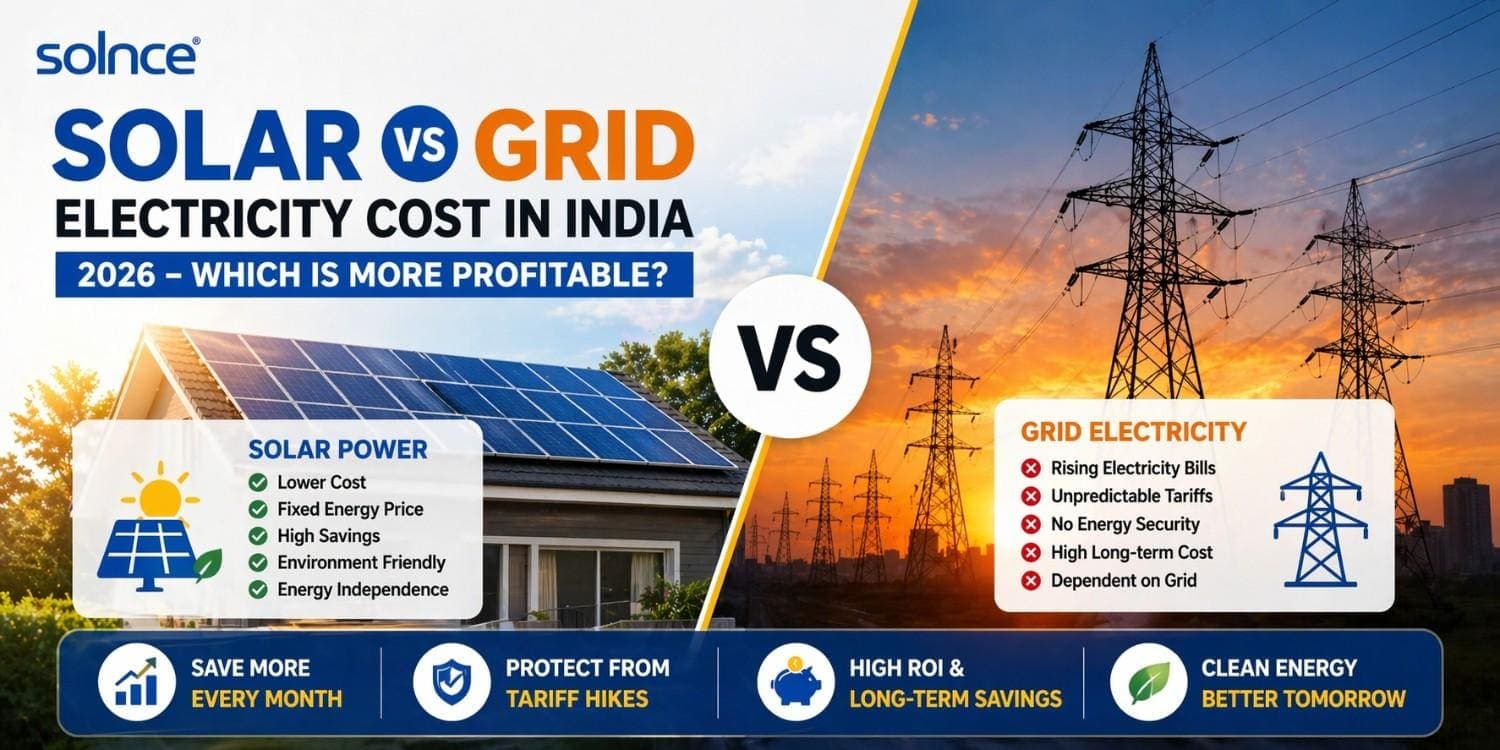
Grid electricity feels convenient because there is no upfront cost, you simply pay the bill that arrives each month. But that monthly bill never stops, and it climbs a little higher every year. Solar asks for an investment today in exchange for nearly free power for decades. Over a 20-year horizon, the difference in total cost is dramatic, and it almost always favours solar.
The hidden cost of staying on the grid
The grid charges you for every single unit, forever. Indian households and businesses pay anywhere from ₹5,000 to ₹50,000 a month depending on size and usage, and that number rarely shrinks. Two forces push it up:
- Tariffs rise roughly 3-5% per year, compounding over time.
- Consumption tends to grow as you add appliances, ACs and equipment.
Add it up over 20 years and a typical user can spend ₹20-40 lakh on grid electricity, money that buys nothing lasting.
What solar costs over the same period
A solar system is a one-time investment of roughly ₹3-6 lakh for a home or small commercial setup. After installation, the per-unit cost of solar power is a fraction of grid rates because sunlight is free. The system typically recovers its cost in 3-5 years and then delivers near-free electricity for the remaining 20+ years of its life. Solar can cut your overall electricity bill by 70-90%.
Solar vs grid: 2026 comparison
| Factor | Rooftop Solar | Grid Electricity |
|---|---|---|
| Upfront cost | ₹3-6 lakh (one-time) | None |
| Running cost per unit | Very low (~₹1-3) | Rising (~₹8-12, +3-5%/yr) |
| 20-year total cost | ₹3-6 lakh investment | ₹20-40 lakh in bills |
| Lifespan | 25+ years | Ongoing forever |
| Emissions | Zero | Depends on grid mix |
| Payback | 3-5 years | Never |
| Bill impact | Cut by 70-90% | Climbs every year |
All figures are approximate and depend on your usage, location, roof and state tariff. The takeaway is consistent across India: grid spending only compounds, while solar locks in your cost at the moment of purchase.
The profitability gap explained
Think of it as buying versus renting. Paying grid bills is renting your electricity, you never stop and you never own anything. Installing solar is buying, with a fixed cost and an asset that keeps producing long after it has paid for itself.
The crossover happens early. Within the first 3-5 years your savings have covered the system cost. Everything after that is profit, and over a full 20-year span the saved money can run into tens of lakhs.
What changes the math
Your exact payback depends on a few levers:
- Your current tariff: Higher grid rates mean faster payback.
- System size and quality: Right-sizing avoids over- or under-spending.
- Net metering: Exporting surplus units earns credits and improves returns.
- Subsidies and depreciation: These reduce the effective upfront cost.
To see your own numbers, you can get a free quote tailored to your bill.
Who benefits most
- Homes with high summer bills see the quickest, most visible savings through residential solar.
- Factories and commercial buildings with large daytime loads gain the most in absolute rupees through industrial solar.
- Anyone facing rising tariffs locks in predictable energy costs for decades.
Common myths that hold people back
A few misconceptions keep people paying inflated grid bills longer than they need to:
- "Solar is too expensive." With loans and falling system prices, the EMI is often lower than the bill it replaces.
- "It won't work in my area." Most of India gets ample sunlight; even cloudier regions see strong annual generation.
- "Maintenance is a hassle." Panels mainly need occasional cleaning, easily booked on demand.
- "Payback takes forever." For most users, the system pays for itself within 3-5 years.
Once these myths are set aside, the decision usually comes down to simple arithmetic, and that arithmetic favours solar.
How Solnce helps
Solnce makes solar the easy, profitable choice. In one app you compare transparent quotes from verified installers, cut the price by roughly 10-20%, and arrange financing, installation and maintenance without the usual back and forth. We size your system around your actual grid spend so the payback is real and the savings start fast. Want to stop renting your power and start owning it? Connect with Solnce and find out how quickly solar pays off for you.