Here is an uncomfortable thing for a solar company to publish: you should not take our word for who is trustworthy. You should check.
We are writing this because the rules changed underneath the industry this summer and most buyers do not know it. In ten weeks, the Ministry of New and Renewable Energy took three separate actions that amount to a coordinated crackdown on rooftop solar vendors — and one of them means a vendor can be removed from the national portal, by name, in thirty days.
If your installer is deactivated mid-project, your subsidy is at risk. Fifteen minutes of checking now is worth more than any amount of due diligence afterwards.
What actually changed in 2026
26 May - the serial number loophole closed. MNRE withdrew the relief that allowed vendors to file a legal undertaking when module or inverter serial numbers were duplicated. Vendors must now enter the 16-digit DCR certificate number so serials are pulled from the national portal directly. This existed because duplicate serials were being used to claim subsidy on modules that were not what they claimed to be.
22 June - the complaint SOP. MNRE notified a standard operating procedure for consumer complaints against vendors. The escalation runs: clarification sought by email, eight days to respond; reminder, seven more days; show-cause notice, fifteen more. Portal deactivation within thirty days, and the vendor’s name published on the PM Surya Ghar portal. Listed violations include non-compliant equipment, poor wiring and earthing, delays after taking payment, failure to provide O&M, and obstructing inspectors. There is a thirty-day appeal window and reactivation within a month if the appeal succeeds.
30 July — mandatory branding. Registered vendors must now affix PM Surya Ghar stickers: one per 3 kW of modules at 25×25 mm on the lower-right of the front frame, and 50×50 mm on inverters and ACDBs. Durable outdoor material, not obscuring the OEM nameplate, serial number or QR codes. The vendor bears the entire cost — there is no financial assistance for it. Non-compliance can lead to de-registration.
Read together, these are not three housekeeping circulars. They are a traceability regime: the modules must be what the paperwork says, the installation must carry a visible mark, and a vendor who fails on either can be publicly removed.
The 15-minute check
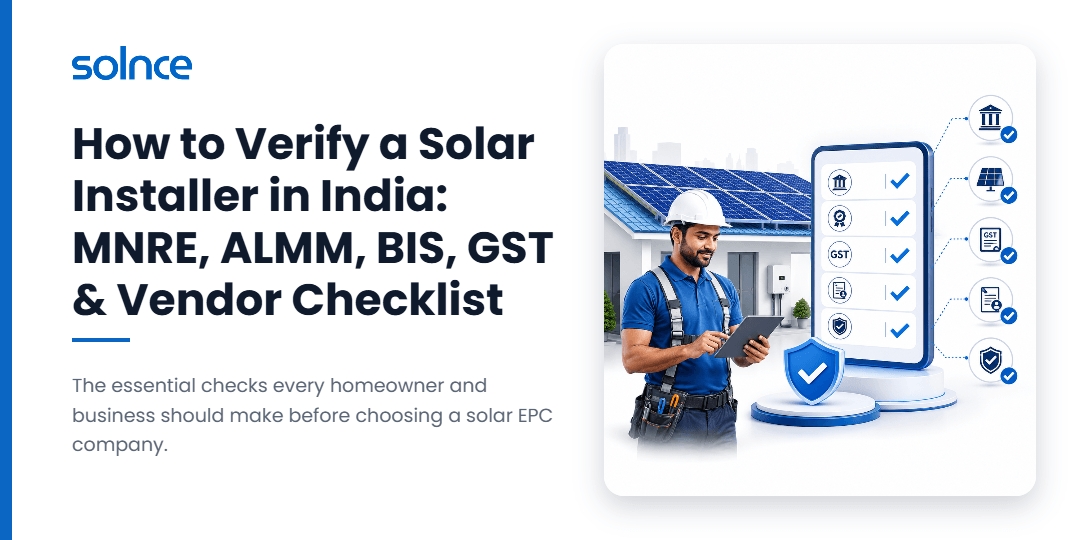
Do these five in order. Any single failure is a reason to pause.
1. Is the vendor registered on the national portal?
Only vendors registered on the PM Surya Ghar National Portal can process your subsidy. This is not a quality badge — it is a precondition. If your installer is not on the state-wise vendor list, your Central Financial Assistance will not be released, regardless of how good the installation is.
Go to pmsuryaghar.gov.in, open Consumer → Registered Vendors, and filter by your state. Search the exact legal entity name, not the trading name — many firms operate under a brand that differs from their registered name. Ask your installer for the registered name in writing and check that.
2. Are the modules ALMM-listed, and on the right list?
There are two lists and buyers routinely conflate them.
- ALMM List-I covers solar modules.
- ALMM List-II covers solar cells, and came into force on 1 June 2026.
Both are published on mnre.gov.in. Ask for the exact make and model number on the quotation — not “Tier-1 panels,” not a brand name alone — and find it on the list.
If you are claiming subsidy, you additionally need DCR-compliant modules: domestically manufactured modules made from domestically manufactured cells. DCR is a separate requirement from ALMM listing. Ask for the DCR certificate number.
3. Does the company legally exist, and is it in good standing?
- MCA / CIN check — search the company name or CIN on the Ministry of Corporate Affairs portal. Confirm it is active, note the incorporation date, and check the registered address matches what is on the quotation.
- GST verification — verify the GSTIN printed on the quotation on the GST portal. An active GSTIN in the correct legal name is a basic test that a surprising number of small installers fail.
A firm incorporated four months ago quoting you a 25-year warranty is not necessarily dishonest. It is a risk you should price consciously.
4. Can they show you executed work you can verify?
Ask for three recent installations in your city, with system size, month of commissioning and — this is the part that separates real firms from brochures — permission to speak to the customer. A firm that has genuinely done the work will make that call happen. A firm that hesitates is telling you something.
Ask what their generation is against what was promised. Ask whether the subsidy came through and how long it took.
5. Read the quotation for what is missing
The absences matter more than the inclusions. Every one of these should be present:
- Module make, model and wattage — not “540W panel”
- Inverter make and model
- Two separate warranty terms: product warranty (typically 10–12 years on Indian modules) and performance warranty (25 years). A quote that says “25-year warranty” without distinguishing them is being loose with you
- Mounting structure specification and galvanisation
- Whether net meter supply, testing and DISCOM approvals are in scope — under the PM Surya Ghar model agreement, they are the vendor’s responsibility
- The five-year comprehensive maintenance obligation, and what it covers
- Performance Ratio at commissioning — the model agreement requires 75%, maintained through the five-year warranty
What “verified” actually means — and what it doesn’t
Three different words get used as if they were interchangeable, and the difference matters when something goes wrong.
Registered means the vendor has an account on the PM Surya Ghar National Portal. It is an administrative status. It confirms the entity exists and has completed onboarding. It is not an assessment of workmanship, and it can be withdrawn — which is the whole point of the June 2026 SOP.
Empanelled usually means a state nodal agency has admitted the vendor to a panel for a specific programme, often against a bank guarantee. It is a higher bar than registration and it is programme-specific: empanelment for one scheme says nothing about another.
Verified, when a marketplace or aggregator uses the word, means whatever that platform’s criteria say it means — and platforms rarely publish those criteria. Ask what was actually checked. At Solnce, an EPC partner is assessed on executed capacity, in-house technical team, safety record and financial standing before onboarding, and re-assessed on delivery. That is our definition. Ask any platform for theirs in writing, and be suspicious if it is not forthcoming.
None of the three is a guarantee. All three are inputs to a decision you still have to make.
Two checks most buyers skip
BIS certification on the products themselves
Solar modules, inverters and storage batteries sold in India fall under a quality control order requiring BIS certification. This is separate from ALMM listing — ALMM is about eligibility for government-supported projects, BIS is about product safety and quality standards.
The PM Surya Ghar model agreement requires the vendor to hand over BIS certificates and IEC/BIS test reports as part of the documentation set. Ask for them by name. A vendor who can produce the ALMM listing but not the BIS certificate has given you half an answer.
Note also that inverters above 200 kW moved from a conditional self-certification window to full BIS certification during 2026. If you are buying at that scale, ask specifically.
State agency status
Registration on the national portal is the central layer. Several states run their own nodal agencies — GEDA in Gujarat, UPNEDA in Uttar Pradesh, and equivalents elsewhere — which maintain their own empanelment lists and, in some cases, have blacklisted vendors and forfeited bank guarantees.
A vendor in good standing centrally may have a problem at state level, or the reverse. If your project is under a state scheme or a state top-up subsidy, check the state agency’s list as well as the national portal. It takes five minutes and almost nobody does it.
The documents to demand before you pay the balance
Clause 7 of the PM Surya Ghar model consumer–vendor agreement lists what your vendor must hand over. Most consumers never ask, and most vendors never volunteer:
- Technical catalogues for modules and inverter
- Warranty certificates for both
- BIS certificates and IEC/BIS test reports
- Module and inverter serial numbers — these are what a future warranty claim depends on
- Warranty cards for panel and inverter
- Layout drawing and electrical single-line diagram
- Structure design and drawing
- Cable specifications
Add to that the DISCOM commissioning certificate, the net metering agreement, and the project completion report on the national portal.
If you take one thing from this article: get the serial numbers, in writing, matched to the modules physically on your roof. A performance warranty claim without traceable serial numbers is very difficult to pursue.
Seven red flags
- A price far below every other quote. In a market where DCR modules carry a real premium over non-DCR imports, a quote well under the field is usually explained by module sourcing, structure gauge, or cable sizing — not efficiency.
- Pressure to pay a large advance before a site survey. Delay after taking payment is one of the violations listed in MNRE’s complaint SOP.
- “We’ll handle the subsidy, don’t worry.” You should be able to see your own application on the national portal, under your own login.
- A guaranteed payback period in writing. Nobody can guarantee payback — it depends on your tariff, your consumption, your state’s metering rules and the weather.
- “Zero electricity bill.” MNRE’s own FAQ says this occurs in very rare cases, because fixed and statutory charges remain payable. A vendor promising it is either uninformed or selling.
- No physical office you can visit.
- Reluctance to put the warranty split, the PR figure or the O&M scope in the written quotation. If it is not in the document, it does not exist.
If something has already gone wrong
Complain to the vendor in writing first, with a deadline. Then use MNRE’s complaint route through the PM Surya Ghar portal — the SOP now puts the Ministry on a clock: eight days for clarification, seven for a reminder, fifteen for show-cause, then deactivation within thirty days, with the vendor named publicly.
Where the dispute is about money or defective work rather than scheme compliance, the District Consumer Commission is available. It handles claims up to ₹50 lakh, filing is free where the consideration paid is up to ₹5 lakh, and the limitation period is two years. File at e-jagriti.gov.in or edaakhil.nic.in.
Note one structural limitation, because it is important and rarely stated: under both the model agreement and MNRE’s warranty SOP, disputes are between you and your vendor. MNRE and the DISCOM are expressly not parties. Your contract is the instrument that protects you, which is why the quotation matters so much.
Frequently asked questions
1. How do I check if a solar company is registered with MNRE?
Go to pmsuryaghar.gov.in, open Consumer → Registered Vendors, and filter by your state. Search the exact registered legal entity name, which may differ from the trading name. Ask your installer for the registered name in writing before you search.
2. What happens if my installer is not registered on the portal?
Your Central Financial Assistance cannot be released. Portal registration is a precondition for subsidy, not a quality mark. An unregistered installer may do excellent work and still cost you ₹78,000.
3. What is ALMM and how do I check if my panels are listed?
The Approved List of Models and Manufacturers. List-I covers modules; List-II covers solar cells and came into force on 1 June 2026. Both are published on mnre.gov.in. Ask for the exact make and model number from your quotation and find it on the list yourself.
4. What is the difference between ALMM and DCR?
ALMM listing means the model is approved for use in government-supported projects. DCR — Domestic Content Requirement — means the module is manufactured in India from domestically manufactured cells. Subsidy under PM Surya Ghar requires DCR compliance; ALMM listing alone is not enough. Ask for the DCR certificate number.
5. Can MNRE remove a solar vendor from the portal?
Yes. Under the SOP notified in June 2026, a vendor who fails to respond to a clarification, a reminder and a show-cause notice can be deactivated within thirty days, with their name published on the PM Surya Ghar portal. There is a thirty-day appeal window and reactivation within a month if the appeal succeeds.
6. What violations can get a vendor deactivated?
The SOP lists non-compliant equipment, poor wiring and earthing, delays after taking payment, failure to provide operation and maintenance, and obstructing inspectors.
7. What happens to my project if my installer is deactivated mid-way?
This is exactly why the check matters. Your subsidy application is tied to a registered vendor, and a deactivation during your project creates real complications. Verify before you sign, not after.
8. Is there a public list of blacklisted solar vendors in India?
MNRE’s SOP provides for deactivated vendors’ names to be published on the PM Surya Ghar portal. Some state agencies have separately blacklisted vendors and forfeited bank guarantees. Check the national portal for current status rather than relying on any third-party list.
9. What documents should I demand from my solar installer?
Per clause 7 of the PM Surya Ghar model agreement: technical catalogues, warranty certificates, BIS certificates, IEC/BIS test reports, module and inverter serial numbers, warranty cards, layout and electrical single-line diagram, structure design and drawing, and cable details. Plus the commissioning certificate and net metering agreement.
10. Why do the module serial numbers matter so much?
A performance warranty claim requires the module to be traceable to your commissioning record. Without serial numbers matched to the panels physically on your roof, a claim years later becomes very difficult. Photograph the serial labels at installation.
11. What is the difference between product warranty and performance warranty?
Product warranty — typically 10 to 12 years on Indian modules — covers defects in materials and workmanship: delamination, junction box failure, frame corrosion. Performance warranty — typically 25 years — guarantees the module’s measured output at standard test conditions will not fall below a defined curve. A quotation saying “25-year warranty” without distinguishing the two is misleading.
12. What warranty is legally required?
MNRE’s SOP of 6 May 2026, as reported, mandates a minimum 10-year product warranty and 25-year performance warranty for modules under PM Surya Ghar and PM-KUSUM, with warranty starting from installation if within six months of the manufacturer’s invoice — otherwise reduced proportionately.
13. What maintenance does my installer owe me?
Under the PM Surya Ghar model agreement, five years of comprehensive operation and maintenance from the date of commissioning by the DISCOM, including overhauling, wear and tear, and regular health checks — with non-performing components repaired or replaced free of cost. The vendor must also educate you on module cleaning.
14. Should I be suspicious of a much cheaper quote?
Investigate it rather than dismiss it. DCR-compliant modules carry a real premium over non-DCR imports, so a large gap usually reflects module sourcing, structure gauge or cable sizing rather than better efficiency. Ask which specific component differs and why.
15. Can I check a solar company’s GST and registration?
Yes. Verify the GSTIN printed on the quotation on the GST portal, and search the company name or CIN on the Ministry of Corporate Affairs portal. Confirm active status and that the registered address matches the quotation.
16. My installer says they’ll handle the subsidy application. Is that normal?
Vendors assist, but the application is yours and you should have your own login on pmsuryaghar.gov.in and be able to see your application status. A vendor who will not let you see your own application is a concern.
17. What if my installer stops responding after taking payment?
Complain in writing with a deadline, then escalate through the PM Surya Ghar portal — delay after payment is a listed violation under the June 2026 SOP, which now puts MNRE on a defined timetable. For money or defective work, the District Consumer Commission handles claims up to ₹50 lakh, free to file up to ₹5 lakh consideration, within two years.
18. Can MNRE or the DISCOM resolve a dispute with my vendor?
No, and this surprises people. Both the model agreement and the warranty SOP place disputes strictly between consumer and vendor — MNRE and the DISCOM are expressly not parties. Your written contract is what protects you.