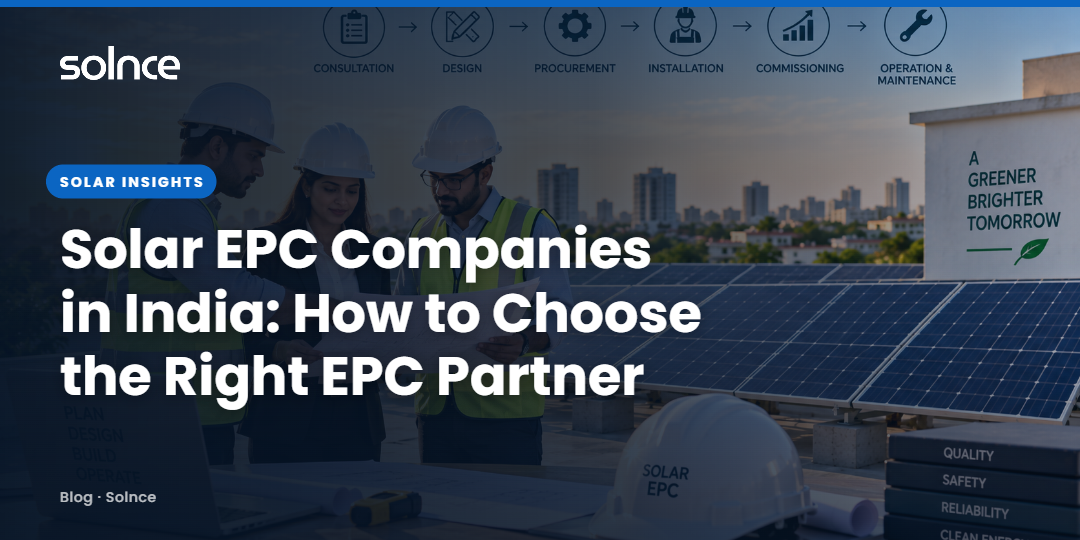
Solar EPC Companies in India: How to Choose the Right EPC Partner in 2026
Last updated at : Oct 27, 2026
Search for solar EPC companies and you get lists. Rankings, “top 10” pages, logos in a grid. None of it tells you whether a company will size your system honestly, get your net meter sanctioned, and still answer the phone in year four.
This guide is deliberately not a ranking. It is a method. You will get a plain-English explanation of what EPC means, how an EPC differs from a dealer, a channel partner and a RESCO developer, why the right partner changes with project size, and a 15-point checklist you can score any shortlisted company against.
You will also get the parts most articles skip: how to verify claims using public records, how to read a quotation line by line, what a proper bill of quantities looks like, which scope items separate a good EPC from a cheap one, and 2026 price benchmarks per kW and per MW.
Quick Answer
An EPC (Engineering, Procurement, Construction) company designs your solar plant, buys the equipment, builds it and hands over a working system. Choose one by verifying credentials rather than claims: GST registration, listing on the PM Surya Ghar National Portal, an electrical contractor licence, ALMM status of the exact module quoted, MCA financial filings, and site visits to systems they built three or more years ago. Price matters, but scope and warranty terms matter more.
What EPC Actually Means
EPC stands for Engineering, Procurement and Construction. It is a single-contract model: one company takes responsibility for the whole plant instead of you buying panels from one place, an inverter from another and hiring a fitter separately. The three letters are three distinct bodies of work, and a weak EPC is usually weak in one of them.
Engineering is the design stage: site survey, year-round shade analysis, structural assessment, load study, string sizing so the array matches the inverter’s voltage window, cable sizing, earthing and lightning protection design, and a single-line diagram (SLD) the DISCOM will approve. The structure design should state the wind speed it is built for, based on IS 875 Part 3 wind zones. Coastal Gujarat sits in a higher wind zone than inland Madhya Pradesh, and the structure should reflect that.
Procurement is buying, and this is where margin games happen. The EPC should name the exact make and model of module, inverter, cable, connectors, structure grade and protection devices, then supply exactly those. Substitution “because of availability” is the most common complaint in the Indian market.
Construction covers civil work, structure erection, DC and AC wiring, earthing pits, the DCDB and ACDB, meter co-ordination, insulation and earth resistance testing, and a handover file with warranty certificates and as-built drawings. A genuine EPC also carries the liaison work: net metering application, feasibility, inspection, subsidy filing and commissioning certificates. That paperwork is often 30 to 90 days of the project, and it is where most delays live.
EPC vs Dealer vs Channel Partner vs RESCO
These four words get used interchangeably in sales calls. They are not the same thing, and the difference decides who is liable when something fails.
| EPC contractor | Dealer / reseller | Channel partner | RESCO / OPEX developer | |
|---|---|---|---|---|
| What they sell | A working plant, turnkey | Equipment, sometimes with fitting | A brand’s systems in a territory | Electricity, per unit |
| Who designs | Their own engineering team | Often the manufacturer’s generic layout | Brand’s design template | Their own team |
| Who owns the asset | You | You | You | The developer |
| Upfront cost to you | Full system cost | Full system cost | Full system cost | Usually zero |
| Single point of accountability | Yes | Rarely | Partly, split with the brand | Yes |
| Typical warranty backing | Their own workmanship warranty plus manufacturer warranties | Manufacturer only | Manufacturer, with brand support | Not applicable, they carry the risk |
| Best for | Anything from 3 kW to multi-MW where you want to own the asset | Buyers with their own contractor | Buyers who want one specific brand | C&I buyers wanting savings without capex |
| Main risk | Choosing a weak EPC | No one owns the outcome | Limited design flexibility | Long lock-in, tariff escalation |
A RESCO (Renewable Energy Service Company), also called the OPEX model, works differently. The developer funds, builds, owns and maintains the plant on your roof, and you sign a power purchase agreement (PPA) to buy the units generated at an agreed rate, usually for 15 to 25 years. In 2026 C&I rooftop PPA rates commonly sit around ₹3.00 to ₹4.50 per unit depending on load profile, credit rating and state, with escalation of 0 to 3% a year. You save from day one without capex, but you do not own the asset and you carry contract risk instead of equipment risk.
Open access is a fourth structure. The plant is not on your roof at all; it sits in a solar park and power is wheeled to your factory through the grid. Under the Green Energy Open Access Rules 2022 the minimum contracted load fell from 1 MW to 100 kW. Landed cost depends heavily on wheeling charges, cross-subsidy surcharge and banking rules, all of which vary by state.
Why the Right Partner Changes by Segment
A company that is excellent at 3 kW homes is not automatically right for a 2 MW plant, and vice versa.
Residential rooftop (1 to 10 kW). Local presence, DISCOM familiarity, PM Surya Ghar paperwork and service response time matter most. A company two districts away will be slow when your inverter faults. This is the one case where searching solar EPC companies near me genuinely makes sense.
C&I rooftop (25 kW to 5 MW). Structural engineering and safety dominate: roof load calculations on industrial sheeting, walkway access, fall arrest anchors, fire clearances, HT side interfacing and real monitoring. The EPC needs enough balance sheet to hold materials and enough discipline to work around your production schedule.
Ground-mount (1 MW and above). Geotechnical study, pile design, structure engineering, tracker versus fixed tilt, HT switchyard, CEIG approval and grid synchronisation. Shortlist only companies that have commissioned plants of that size.
Open access. Here you are choosing a developer, not a builder. Creditworthiness, land control, connectivity approvals and knowledge of state open access rules matter more than installation crews.
The 15-Point Evaluation Scorecard
Score each shortlisted company on every item: 0 means absent, 1 means partial or verbal, 2 means documented and verified. A serious contender should clear roughly 24 out of 30.
| # | Group | What to check | How to verify | Score /2 |
|---|---|---|---|---|
| 1 | Credentials | GST registration active | Search the GSTIN on the GST portal | |
| 2 | Credentials | Registered vendor on PM Surya Ghar National Portal | Vendor list on pmsuryaghar.gov.in for your state and district | |
| 3 | Credentials | Valid electrical contractor licence, Class A for larger work | Licence copy plus state electrical inspectorate record | |
| 4 | Credentials | Company age and legal form | MCA master data, incorporation date, directors | |
| 5 | Credentials | ISO 9001 (quality), ISO 14001 (environment), ISO 45001 (safety) | Certificate number checked with the issuing body | |
| 6 | Technical | In-house design engineers, not outsourced | Ask to meet the engineer who will size your plant | |
| 7 | Technical | Trained installation crew, Suryamitra or equivalent | Training certificates for the actual site team | |
| 8 | Technical | Modules on ALMM List-I, exact model number | MNRE ALMM list, match the model string letter by letter | |
| 9 | Technical | IEC 61215 and IEC 61730 for modules, IEC 62109 for inverters, BIS registration | Test certificates from an accredited lab, BIS licence at bis.gov.in | |
| 10 | Commercial | Itemised BOQ with makes and models | The quotation itself | |
| 11 | Commercial | Payment milestones tied to delivery, not calendar dates | Draft contract | |
| 12 | Commercial | Financial health, positive net worth, filings up to date | MCA annual returns and financial statements | |
| 13 | Service | Written workmanship warranty, minimum 5 years | Contract clause, not a brochure line | |
| 14 | Service | O&M or AMC terms with a defined response SLA | AMC draft with penalty for breach | |
| 15 | Service | Verifiable installations 3+ years old that you can visit | Two customer references you contact yourself |
The highest-value item on that list is number 15. Anyone can show you a plant commissioned last month. Ask for one built in 2022 or earlier, then go and look at the cable trays, the earthing pits and the structure’s rust.
EPC stands for Engineering, Procurement and Construction. It means one company handles design, buys all the equipment, installs it, gets approvals and hands over a working plant. You sign one contract and have one point of accountability. The alternative is buying equipment from a dealer and arranging installation and approvals yourself, which usually costs less on paper and more in practice.
Q2. Are solar EPC companies in India regulated?
Partly. There is no single licence called “solar EPC”. But installers doing subsidised residential work must be registered vendors on the PM Surya Ghar National Portal, electrical work requires a state electrical contractor licence, and equipment must meet BIS and ALMM requirements. Beyond that, ISO certifications are voluntary. So the burden of verification sits with the buyer.
Q3. How do I find good solar EPC companies near me?
Start from the PM Surya Ghar National Portal vendor list filtered to your state and district, which gives you registered vendors rather than advertisers. Then ask each shortlisted company for two local installations you can visit, ideally at least three years old. Local matters mainly for service response and DISCOM familiarity, both of which decide your experience after commissioning.
Q4. Is a bigger EPC company always better?
No. Large national players bring process discipline, balance sheet strength and bankability, which matters for MW-scale projects and RESCO contracts. Good regional EPCs often give faster service and better DISCOM navigation on small rooftops. Match the size of the company to the size and complexity of your project rather than assuming scale equals quality.
Q5. What is the difference between an EPC and a channel partner?
A channel partner sells and installs a specific manufacturer’s systems in a defined territory, using that brand’s designs and support. An EPC is brand-neutral and does its own engineering, so it can pick the module and inverter that suit your site. Channel partners can be excellent, but you get less design flexibility and the accountability is shared with the brand.
Q6. Should I choose CAPEX or RESCO for my factory?
CAPEX means you own the plant, take the full savings and the full risk, and get accelerated depreciation benefits. RESCO means zero upfront cost and you buy units at roughly ₹3.00 to ₹4.50 per unit under a 15 to 25 year PPA. CAPEX gives higher lifetime returns if you have the capital and a stable business. RESCO suits companies who would rather deploy capital elsewhere.
Q7. What is ALMM and why does it matter when choosing an EPC?
ALMM is MNRE’s Approved List of Models and Manufacturers. List-I covers module models and is mandatory for subsidised, government and net-metered projects. List-II covers domestic solar cells and came into force on 1 June 2026 for those project categories. If your EPC supplies a non-listed module, your net meter and subsidy can both be rejected at inspection.
Q8. How has ALMM List-II affected prices in 2026?
Domestic cell manufacturing capacity is still below module demand, which has tightened supply for compliant projects. Analysts have flagged utility-scale system prices rising by up to roughly 20% through the fourth quarter of 2026. Rooftop residential systems have been less affected because DCR requirements already applied there. Expect quotes to be valid for shorter periods than in previous years.
Q9. What certifications should a solar EPC company hold?
At minimum, GST registration, a valid electrical contractor licence, and registration on the PM Surya Ghar portal for residential subsidised work. Beyond that, ISO 9001 for quality, ISO 14001 for environment and ISO 45001 for occupational safety are meaningful for C&I and ground-mount work. Suryamitra-trained technicians on the actual site crew are a good sign for installation quality.
Q10. Which standards should the equipment meet?
Modules should carry IEC 61215 for design qualification and IEC 61730 for safety, and be BIS registered under IS 14286. Inverters should meet IEC 62109 for safety and be BIS registered under IS 16221, with anti-islanding protection. Ask for test certificates from an accredited laboratory and cross-check the BIS licence number rather than accepting a logo on a datasheet.
Q11. How much should a 100 kW C&I rooftop system cost in 2026?
Roughly ₹35,000 to ₹45,000 per kW turnkey, so about ₹35 lakh to ₹45 lakh for 100 kW, depending on roof type, structure height, safety scope and module brand. GST on solar devices is 5% since 22 September 2025. Anything materially below that range usually means thinner structure, undersized cable, or safety and monitoring scope removed.
Q12. What is a fair advance payment to an EPC?
Ten to twenty percent on contract signing and design approval is normal. Total payments before material physically reaches your site should stay under roughly 50%. Keep 10% for commissioning and 5 to 10% as retention released 90 days later or against a bank guarantee. Anyone asking for full payment upfront is transferring their working capital risk to you.
Q13. How long does a rooftop solar project take end to end?
Installation itself is usually 2 to 7 days for residential and 3 to 8 weeks for C&I. The longer part is approvals. Net metering officially runs 15 to 30 days under the Electricity (Rights of Consumers) Rules, 2020, but actual timelines vary by state, from around 20 days in Gujarat to 60 days or more in parts of Rajasthan and Uttar Pradesh.
Q14. What warranty should I insist on in writing?
Four separate items: module product warranty of 10 to 12 years, module performance warranty over 25 to 30 years, inverter warranty of 5 to 10 years, and the EPC’s own workmanship warranty of at least 5 years covering structure, wiring, earthing and roof waterproofing. Get all four in the contract with durations and a named claims process, not in a brochure.
Q15. What does a solar AMC cost per year?
Indicative 2026 rates are ₹2,500 to ₹4,000 per kW per year for small residential systems, ₹1,500 to ₹2,500 for 10 to 50 kW, ₹1,000 to ₹1,800 for 50 to 200 kW and ₹800 to ₹1,500 above 200 kW. Under PM Surya Ghar, five years of O&M is normally included with the installation, so AMC pricing becomes relevant from year six.
Q16. How do I check an EPC company’s financial health?
Search the company on the MCA portal using its CIN. Look at incorporation date, paid-up capital, whether annual returns and financial statements are filed up to date, and whether net worth is positive. A long warranty from a thinly capitalised or non-filing company is worth very little. This check costs a few hundred rupees and takes about twenty minutes.
Q17. Can I claim the PM Surya Ghar subsidy through any EPC?
No. The installer must be a registered vendor on the PM Surya Ghar National Portal, and the system must use ALMM List-I modules with DCR cells, be grid connected and net metered. Subsidy is ₹30,000 for 1 kW, ₹60,000 for 2 kW and ₹78,000 for 3 kW and above, which is the cap. It is paid by direct bank transfer after commissioning.
Q18. What is open access solar and do I need an EPC for it?
Open access means buying solar power from an off-site plant, wheeled to you through the grid. The minimum contracted load is 100 kW under the Green Energy Open Access Rules 2022. You are choosing a developer rather than a builder, so evaluate their land control, connectivity approvals, creditworthiness and understanding of state wheeling charges, banking rules and cross-subsidy surcharge.
Q19. How much generation should I expect, and can I hold the EPC to it?
In India, 1 kW typically generates 4 to 4.5 units a day, roughly 1,400 to 1,600 units a year, with Gujarat and Rajasthan at the higher end. Ask the EPC to state expected annual generation in the contract along with the performance ratio assumed. For C&I projects you can negotiate a generation guarantee with a shortfall compensation clause.
Q20. What is the single biggest mistake buyers make?
Comparing quotes on ₹/kW without comparing scope. Two quotes for the same system size can differ by 25% purely because one includes proper structure galvanising, correctly sized cable, lightning protection, walkways and monitoring while the other does not. Build a like-for-like comparison table from the BOQs first, then look at price.
Talk to a Solnce Expert
Solnce Energy has installed over 100 MW of solar and serves 1,500+ customers across rooftop, C&I, solar parks and PPAs. We are based in Surat, Gujarat, and were backed on Shark Tank India Season 4. If you want a second opinion on a quotation you have already received, our engineers will read the BOQ line by line and tell you what is missing. Ask us for a site survey and a written, itemised proposal you can compare against anyone else’s.