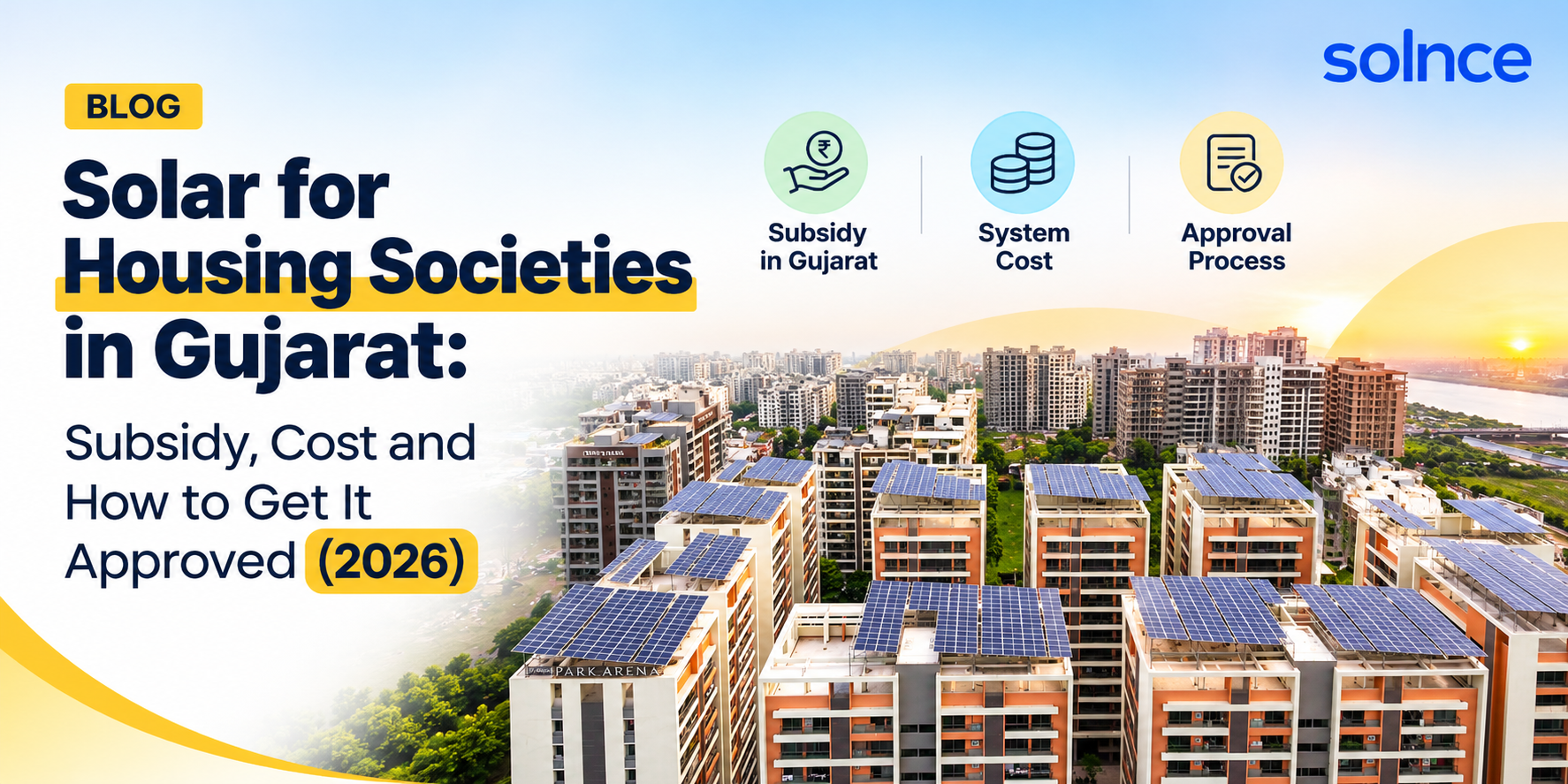
Solar for Housing Societies in Gujarat: Subsidy, Cost and How to Get It Approved (2026)
Last updated at : Oct 27, 2026
Quick answer: A housing society in Gujarat can put solar on its terraces to run lifts, water pumps, common lights and EV chargers. Under PM Surya Ghar, the central government gives ₹18,000 per kW for common-facility systems, up to 500 kW (3 kW per house). The committee proposes it, the general body approves it, and an installer like Solnce handles the paperwork.
If your society's maintenance charge keeps rising, look at the common electricity bill. Lifts, water pumps, corridor lights, the clubhouse and the gate all run on it. In a high-rise, this is often the society's single largest monthly expense. Solar on the terrace attacks exactly that bill. The panels produce most in the daytime, when pumps and lifts are busy. What the society does not use goes to the grid and is adjusted against the bill. This guide is for committee members and residents in Surat and across Gujarat. It covers the subsidy, cost, savings, the approval process and a real Surat example.
What can a society solar plant power?
A common-facility plant is connected to the society's common electricity meter, not to individual flats. It can power: • Lifts in every tower • Water pumps (borewell, transfer and fire pumps) • Corridor, staircase, parking and street lights • The clubhouse, gym, community hall and security cabin • EV chargers in the common parking (the subsidy explicitly covers EV charging for common facilities)
Individual flats can still get their own rooftop systems under the household part of the same scheme, where roof space allows. That is a separate application by each owner. See our guide to the PM Surya Ghar scheme for the household subsidy.
The subsidy for housing societies (PM Surya Ghar, 2026)
PM Surya Ghar: Muft Bijli Yojana gives a separate central subsidy for group housing societies (GHS) and resident welfare associations (RWA). Here is how it works, as published in the scheme's subsidy structure:
| Item | What the scheme says | | Subsidy rate | ₹18,000 per kW | | What it covers | Common facilities, including EV charging | | Maximum capacity | 500 kW per society | | Per-house limit | 3 kW per house | | Counts towards the 500 kW | Individual rooftop plants installed by residents in the same society | | Where to apply | The national portal, pmsuryaghar.gov.in |
How to work out your society's limit. Multiply the number of houses by 3 kW. Your limit is that number or 500 kW, whichever is lower. • A society with 60 flats: 60 × 3 = 180 kW. Maximum subsidy = 180 × ₹18,000 = ₹32.4 lakh. • A society with 200 flats: 200 × 3 = 600 kW, so the 500 kW cap applies. Maximum subsidy = 500 × ₹18,000 = ₹90 lakh. Remember that flats that already took their own subsidised rooftop systems use up part of the same 500 kW.
Society solar or solar on each flat?
Both are possible, and many societies do both. They solve different bills.
| Point | Common-facility (society) | Individual flat systems | | What it powers | Lifts, pumps, common lights, EV chargers | Each flat's own usage | | Who pays | The society | Each flat owner | | Subsidy | ₹18,000 per kW, up to 500 kW | Up to ₹78,000 per home | | Who applies | The society | Each owner | | Roof space | Shared terrace | Needs a share of terrace per flat | | Best for | Cutting maintenance charges | Cutting each family's own bill |
In a high-rise, the terrace is small compared with the number of flats. So it usually cannot fit a full system for every family. A common plant uses the space for the load everyone shares, which is the fairest use of a shared roof. Low-rise societies and row houses with more roof per family can often do both.
Choosing the right plant size
Bigger is not always better. The right size depends on three numbers:
- Common load Your monthly common-area units from the bills. This is the main guide.
- Usable shadow-free terrace. Each kW needs roughly 60-70 sq ft. Water tanks, lift rooms, solar water heaters and parapets reduce this.
- Subsidy limit. 3 kW per house, up to 500 kW. A good proposal sizes the plant so most of what it produces is used by the society itself, with a modest surplus in summer. Ask your installer to show the month-by-month generation against your month-by-month common load. If the plant produces far more than you use, the extra units are settled at a lower rate, which stretches the payback.
How much does a society solar plant cost?
Cost depends on plant size, the type of structure, how high the panels must be raised, and cable length from each terrace to the common meter. The table below shows indicative ranges from Solnce quotes.
What pushes cost up: elevated structures (so the terrace stays usable), long cable runs across several towers, extra safety walkways, and splitting one plant across many small terraces. What brings cost down: one large shadow-free terrace, panels mounted close to the roof, and a single common meter.
How much will the society save?
Savings come from the units the plant produces, multiplied by what the society pays per unit on its common meter. A simple way to estimate:
- Take the society's average monthly common-area units from the last 12 bills.
- Size the plant to cover most of the daytime load, within the subsidy limit.
- Multiply the expected monthly units by your per-unit rate (energy charge plus duty).
- Compare the yearly saving with the cost after subsidy. That gives the payback.
Use the Solnce solar calculator for a first estimate, then ask us for a site survey for an accurate number. Our guide to [solar payback](/service/residential-solar) in India explains the maths in more detail.
How a society decides: step by step
Most delays in society projects come from the decision process, not the installation. Here is the path that works:
- A committee member raises it. Collect the last 12 months of common-area bills.
- Free site visit. The installer checks terraces, shade, structure strength, the common meter and cable routes.
- Proposal. Plant size, cost, subsidy amount, monthly savings, and payback, in writing.
- Committee meeting. The installer presents and answers questions. Solnce does this for free.
- General body resolution. Members approve the project and how it will be paid for. Keep the minutes; the subsidy application needs society documents.
- Application. Filed on the national portal and with the DISCOM (DGVCL, Torrent Power or your local DISCOM).
- Installation. Usually 10-12 days on site for a [100 kW] plant.
- Net meter and commissioning. The DISCOM installs the bidirectional meter. See our guide to net metering, net billing and gross metering.
- Subsidy release. After inspection, the subsidy is paid into the society's bank account.
- Maintenance. Regular cleaning and monitoring keep generation high.
How does the society pay for it?
• Sinking fund or reserve fund. Fastest if the society has savings. The subsidy comes back later. • One-time contribution from members. Split by flat, often recovered within a few years of lower maintenance. • Loan. Several banks offer rooftop solar loans. See our guide to the solar panel loan in India. • Mix. Part reserve fund, part loan. Ask the installer to show the cash flow for each option, month by month, so members can see when the savings overtake the payment.
Maintenance and monitoring after installation A solar plant needs little work, but not zero. Plan for these from day one: • Cleaning. Dust and bird droppings cut output. In Surat, most plants need cleaning every [2–4] weeks, more often in dry months. Decide who does it: the society's staff, or the installer under an AMC. • Monitoring. Generation should be checked weekly. A sudden drop on one tower usually means a tripped breaker, an inverter fault or heavy dirt. With the Solnce app, the committee sees live generation without visiting the terrace. • Yearly check. Tightening of connections, earthing tests, inverter checks and a look at the structure after the monsoon. • Warranties. Keep the panel, inverter and workmanship warranties in the society's records, with the installer's contact.
Assign one committee member to own the plant. That single step prevents most of the "the plant stopped working and no one noticed" problems.
Common mistakes societies make
• Sizing to the full terrace instead of the load. Extra units may earn little. Size to the common load first. • Ignoring shade. Water tanks, lift rooms and neighbouring towers cast shadows. Ask for a shade study. • Skipping the general body resolution. It delays the subsidy application. • Choosing on price alone. Check panel and inverter brands, structure quality, warranties in writing, and who handles maintenance. • No cleaning plan. Dust is heavy in Surat. Uncleaned panels lose output. Agree on a cleaning schedule before installation.
Why societies in Surat choose Solnce
• A Surat team, with an office in Vesu, since 2021. • Real society experience, including Shreepad Park Arena and many more. • We present to your committee and general body for free. • We handle the national portal, DISCOM approvals, net metering and subsidy paperwork. • Our app lets the committee see live generation and raise service requests. Read more about our rooftop solar for homes and societies and our work as a solar company in Surat.
Planning solar for your society?
Book a free committee meeting. Send us your last 12 months of common-area bills and the number of flats, and we'll come with a first estimate. Book a free society meeting WhatsApp us: +91-70411 66814
Frequently asked questions
-
Can a housing society get a solar subsidy in Gujarat? Yes. Under PM Surya Ghar, group housing societies and RWAs get ₹18,000 per kW for solar that powers common facilities, up to 500 kW (3 kW per house). Check current terms on pmsuryaghar.gov.in.
-
How much subsidy can our society get at most? Up to 500 kW × ₹18,000 = ₹90 lakh. Smaller societies are limited to 3 kW per house. A 60-flat society can get up to 180 kW, or ₹32.4 lakh.
-
Does the 500-kW limit include solar on individual flats? Yes. Individual rooftop plants installed by residents in the same society count towards the 500-kW limit.
-
Is EV charging covered? Yes. The scheme lists EV charging as part of the common facilities a society plant can power.
-
What can a society solar plant run? Lifts, water pumps, common lights, the clubhouse, gym, security cabin and EV chargers. Anything on the society's common meter.
-
Can each flat owner also get solar? Yes, under the household part of PM Surya Ghar, if roof space allows. That is a separate application by each owner, with its own subsidy of up to ₹78,000.
-
How much roof space do we need? Roughly 60 sq ft of shadow-free terrace per kW. Water tanks and lift rooms reduce usable space. A site visit gives the real figure.
-
Can we use terraces on several towers? Yes. Panels on several towers can feed one common meter. Cable length adds cost, so the design should keep runs short.
-
How long does installation take? About 10-14 days on site for a [100 kW] plant. Approvals and net metering add time; plan for [X–Y] weeks in total.
-
Who applies for the subsidy? The society applies on the national portal, with society documents. Solnce prepares and files it for you.
-
What documents does the society need? Usually, the society registration, the general body resolution, recent common-area electricity bills, the society bank account details and authorisation for the installer.
-
Do we need a general body resolution? Yes. Members should approve the project and how it is paid for. Keep the minutes; they are needed for the application.
-
How long until the subsidy is paid? After the plant is installed, inspected, and the net meter is fitted, the subsidy is released to the society's bank account. Timing varies; Solnce tracks it until it arrives.
-
What is the payback period? Often 4-5 years after subsidy, depending on cost, generation and your per-unit rate. We give you an exact figure in the proposal.
-
Will solar work during a power cut? A normal grid-connected plant switches off during a power cut for safety. To run essential loads during cuts, you need a battery or hybrid system.
-
What happens to extra power on holidays? It goes to the grid through the net meter and is adjusted against the society's bill, as per your DISCOM's rules.
-
Will panels damage our terrace or cause leaks? Not if installed correctly. Structures should be fixed without damaging waterproofing, or use ballast. Ask how the installer protects the terrace.
-
Can we still use the terrace? Yes, if panels are raised on an elevated structure. It costs more but keeps the space usable.
-
Who maintains the plant? The installer usually provides maintenance under an AMC: cleaning, monitoring and repairs. Agree on this before signing.
-
How do we choose an installer? Check real society projects, panel and inverter brands, written warranties, who handles approvals and subsidies, and the maintenance plan. Visit a project they have finished.