Ground-Mounted Solar Panels: The Smart Choice for High Electricity Consumers
Last updated at : Aug 13, 2026
When your roof runs out of space but your electricity demand keeps climbing, the ground becomes your best asset. Ground-mounted solar puts panels on open land rather than a rooftop, removing the constraints that limit so many high-consumption sites. For factories, farms, hospitals and large homes, it is often the most productive way to go solar.
What Is a Ground-Mounted System?
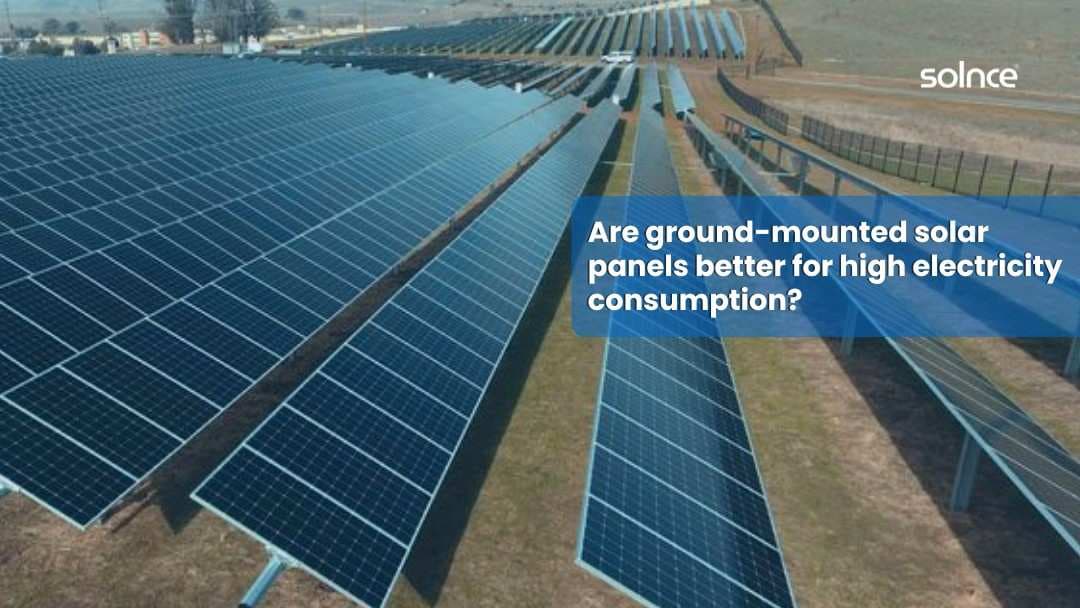
Instead of fixing panels to your roof, a ground-mounted system installs them on a metal structure anchored into open land. Because you are not limited by roof size, shape or strength, you can build exactly the capacity you need, from a few hundred kilowatts to several megawatts, and orient every panel for maximum sunlight.
There are two common approaches:
- Fixed-tilt structures set panels at the optimum angle for your location and stay put. They are simpler and cheaper.
- Tracking structures rotate to follow the sun across the day, squeezing out more generation at a higher cost.
Why High Consumers Choose Ground Mounts
Sites with heavy, steady electricity use, such as manufacturing units, cold storage, data centres and hospitals, benefit most because they can build large systems that match their load. The advantages stack up:
- No roof-size limit, so you can install the full capacity your bills justify.
- Optimal orientation and tilt for every panel, lifting overall generation.
- Easier cleaning and maintenance, since panels are at ground level.
- Better airflow beneath panels, which keeps them cooler and more efficient in India's heat.
- Room for bifacial panels, which capture light reflected off the ground for extra yield.
For large-scale systems serving high-consumption facilities, the payback period can be as short as three to five years, after which the energy is effectively free for decades.
Rooftop vs Ground-Mounted
| Factor | Rooftop | Ground-Mounted |
|---|---|---|
| Space limit | Roof area only | Open land, highly scalable |
| Orientation | Fixed by roof | Optimised for the sun |
| Maintenance access | Harder, at height | Easy, at ground level |
| Cooling/airflow | Limited | Excellent |
| Land requirement | None | Needs spare land |
The catch, of course, is that you need available land. If you have it, a ground mount almost always out-generates the same capacity on a roof.
Tracking the Numbers: Generation and Returns
Because every panel can be tilted and oriented for maximum sun, a well-designed ground mount typically generates more per kilowatt installed than the same capacity squeezed onto a constrained roof. Add bifacial panels, which capture light reflected off the ground, and the yield rises further. For energy-hungry facilities, this higher generation, combined with the heavy electricity bills these sites already pay, is what drives the short three-to-five-year payback on large systems.
The economics improve further with net metering or open-access arrangements, where surplus generation offsets grid consumption or is sold. Over a 25-year-plus life, a ground-mounted plant becomes one of the most cost-effective assets a high-consumption business can own.
Land and Approvals to Plan For
Going ground-mounted means thinking about land and permissions early:
- Land area: as a rough guide, every megawatt needs roughly 4–5 acres, though this varies with panel efficiency and layout.
- Land use and approvals: confirm the land's zoning and any local clearances needed before you build.
- Grid connectivity: check the distance to the nearest connection point, as long runs add cost.
- Net metering or open access: decide how you will use or sell surplus power.
Sorting these out at the planning stage avoids costly surprises once construction begins.
Design Factors to Get Right
A productive ground-mounted system depends on good design:
- Site and soil survey to choose the right foundation, whether driven piles or concrete footings.
- Spacing between rows to avoid panels shading one another, especially in winter.
- Drainage and flood risk assessment so the structure stays stable through monsoon.
- Cabling and inverter placement to minimise losses over the larger area.
- Security and fencing for open-site installations.
For homeowners with a small or shaded roof, a modest ground mount can also be a neat alternative to rooftop panels, complementing or replacing a residential solar install.
How Solnce Helps
At Solnce Energy we design and build ground mounted solar systems sized precisely to your land and your load, from compact home arrays to large commercial and industrial plants. Our team handles the site survey, structural design, installation and the MNRE and net-metering paperwork end to end. Explore our services or read more on the solar blog, and when you are ready to put your land to work, get a free quote for a system built around your consumption.