How to Choose the Right Solar Pump for Your Needs
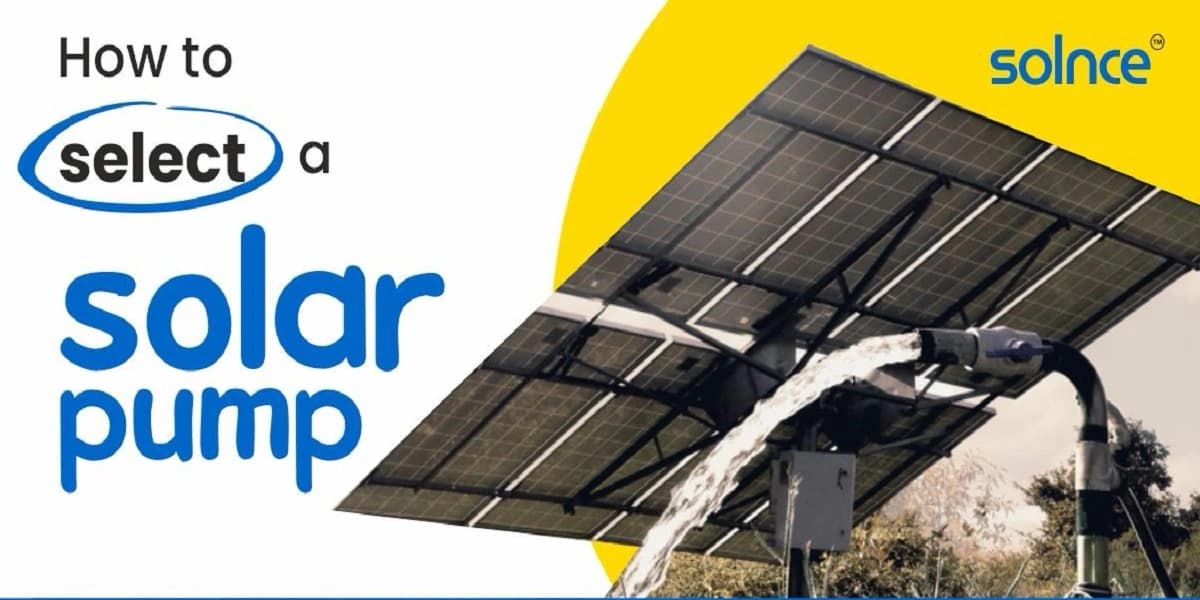
Last updated at : Aug 13, 2026
Choosing a solar pump is not about buying the biggest one you can afford — it is about matching the pump to your water source, your land and your daily water need. Get the match right and the system runs for decades on free sunlight; get it wrong and you either waste money on capacity you never use or end up short of water at the worst moment. This guide walks you through the decisions in the right order.
Step 1: Measure your water depth
The single most important question is how far below the surface your water sits, because it decides the entire type of pump you need.
| Water depth | Pump type |
|---|---|
| Less than about 20 feet (≈6 m) | Surface pump |
| Deeper than about 20 feet | Submersible pump |
A surface pump sits above ground next to the source and works well for shallow water and ponds, canals or shallow wells. A submersible pump goes down inside the borewell, underwater, and is the right choice — often the only choice — when the water table is deep. Know your depth before anything else.
Step 2: Work out how much water you need
Next, estimate your daily water requirement. This depends on:
- The area you irrigate and the crop's water needs
- How many hours of strong sunlight your site gets
- Whether you use efficient drip irrigation or thirstier flood irrigation
A field watered by drip needs a far smaller pump than the same field flooded. Be realistic here — sizing for a worst-case demand you rarely hit just inflates your cost.
Step 3: Match the pump HP and panel size
Once you know depth and daily demand, you can size the pump's horsepower and the solar array that feeds it. The two must be matched — an undersized array will never let the pump reach full flow.
| Pump HP | Typical panel array | Typical use |
|---|---|---|
| 1–2 HP | ~1–2 kW | Small plots, shallow water, drip |
| 3 HP | ~3 kW | Medium farms, moderate borewells |
| 5 HP | ~4.5–5 kW | Larger farms, deeper borewells |
| 7.5 HP+ | ~6.5 kW+ | Big farms, deep borewells, high flow |
These are starting points, not rules — the real figure depends on the head (vertical lift), the pipe length and your sunshine. An engineer's calculation beats a rule of thumb every time.
Step 4: Decide between AC and DC
Both motor types pump water well; the choice is about scale and serviceability:
- DC pumps connect more directly to the panels, are efficient, and suit smaller systems.
- AC pumps use a variable frequency drive and are easy to service with widely available AC motors, making them common at larger sizes.
If easy local repairs matter to you, AC has an edge. If simplicity and efficiency at small scale matter most, DC is attractive.
Step 5: Check the borewell yield
A common and costly mistake is to size the pump to the panels while ignoring the borewell. If your bore only yields a modest flow, an oversized pump will draw it dry, run hot and wear out. The pump's capacity must respect how much water the source can actually deliver.
Step 6: Factor in PM-KUSUM
Before you finalise anything, check the PM-KUSUM scheme. It offers substantial central and state subsidies on solar pumps, so a farmer often pays only a fraction of the full price. Subsidy percentages and the farmer's contribution differ by state and change year to year, so confirm your state's current notification — it can change which pump size is affordable for you.
A quick selection checklist
- Measure water depth → choose surface or submersible.
- Estimate daily water need from area, crop and irrigation method.
- Match pump HP and panel size to depth and demand.
- Pick AC or DC based on scale and local service.
- Verify the borewell yield supports the pump.
- Check PM-KUSUM subsidy in your state.
How Solnce helps
Every farm and water source is different, and the right solar pump is the one engineered for yours. Solnce surveys your site, calculates the correct pump and array, guides you through PM-KUSUM, and keeps the system running with practical solar maintenance — the same engineering care we bring to residential solar. Read more on our solar blog, and to get a pump sized for your exact needs, get a free quote.