What Is a Microgrid? A Plain-English Explanation
Last updated at : Aug 13, 2026
A microgrid is, quite literally, a small grid — a self-contained power system that can generate, store and distribute electricity on its own. It can run hand-in-hand with the main utility grid or, when needed, disconnect and run entirely by itself. As India pushes toward reliable, clean and decentralised power, microgrids are moving from a niche idea to a practical solution for everything from remote villages to hospitals and industrial parks.
The simplest way to think about it
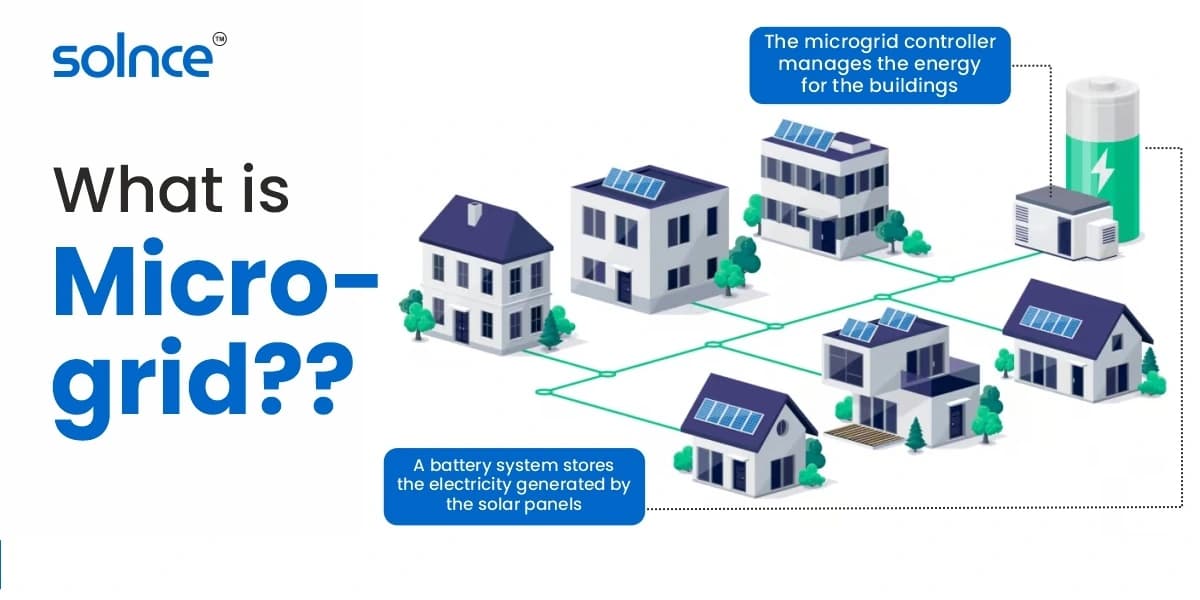
Imagine your neighbourhood, factory or campus had its own miniature power company: panels on the roofs making energy, batteries storing it, and a smart controller deciding moment to moment where power should flow. That is a microgrid. The defining feature is its ability to operate as a single, controllable unit — and to "island" itself from the main grid when the main grid fails.
The building blocks of a microgrid
Every microgrid, large or small, is assembled from the same core components:
- Distributed generating units — the sources that make power, usually solar, sometimes wind, diesel generators or biomass.
- Electric power storage — battery banks (typically lithium-ion, sometimes flow batteries) that hold surplus energy for later.
- Load centres — the homes, machines and facilities that consume the electricity.
- A distribution network — the wiring that ties generation, storage and loads together.
- Control unit(s) — the intelligence that balances supply and demand and manages the connection to the main grid.
The control unit is what separates a microgrid from a simple collection of solar panels. It constantly matches generation to load, charges and discharges storage at the right moments, and decides when to draw from or disconnect from the utility.
On-grid vs off-grid microgrids
Microgrids come in two broad types, and the difference is whether they touch the main utility grid:
| Type | Connection | Where it is used |
|---|---|---|
| Off-grid microgrid | Stands alone, no utility link | Remote villages, islands, mines, telecom towers |
| On-grid microgrid | Tied to the main grid, can island | Hospitals, airports, universities, industrial plants, urban campuses |
Off-grid microgrids are a lifeline where the main grid simply does not reach. They bring reliable electricity to remote and island communities that would otherwise depend on diesel or go without.
On-grid microgrids stay connected to the utility for everyday economy but can cut themselves loose during a grid failure — which is exactly why hospitals, airports and data-heavy campuses invest in them. The grid becomes a convenience, not a single point of failure.
Why solar makes a great microgrid
When the generating source is solar, the microgrid gains a particularly elegant quality: it captures free daytime energy and stores the surplus in battery banks. That stored energy then powers the site through the night or across cloudy days. The result is a clean, quiet system with no fuel cost and very little moving machinery.
The benefits stack up:
- Resilience — keep critical loads running through grid outages.
- Clean energy — solar generation with low emissions and no fuel bills.
- Decentralisation — power made and used locally, reducing transmission losses.
- Scalability — start small and expand generation or storage as needs grow.
Where microgrids fit in India
India's combination of strong sunshine, vast rural geography and a growing need for uninterrupted industrial and institutional power makes it a natural home for solar microgrids. Off-grid versions electrify communities the main grid struggles to reach, while on-grid versions give factories, campuses and healthcare facilities the resilience they cannot afford to be without.
How a microgrid differs from a normal solar system
It is easy to confuse a microgrid with an ordinary rooftop solar setup, but the distinction is real. A typical home solar system feeds your loads and the grid, and goes dark when the grid fails. A microgrid is built around its control unit and storage so that it can keep running independently — islanding from the utility — and can coordinate multiple generation sources and many loads as one managed system. In short, every microgrid uses solar-style components, but not every solar installation is a microgrid. The intelligence and the islanding ability are what set it apart.
How Solnce helps
A microgrid is a serious engineering project — generation, storage, distribution and control all have to work as one system. Solnce brings the same rigour we apply to residential solar to larger, resilient power systems, and backs them with long-term solar maintenance so they keep delivering. To learn more, browse our solar blog, and to explore a microgrid or storage project for your site, get a free quote.