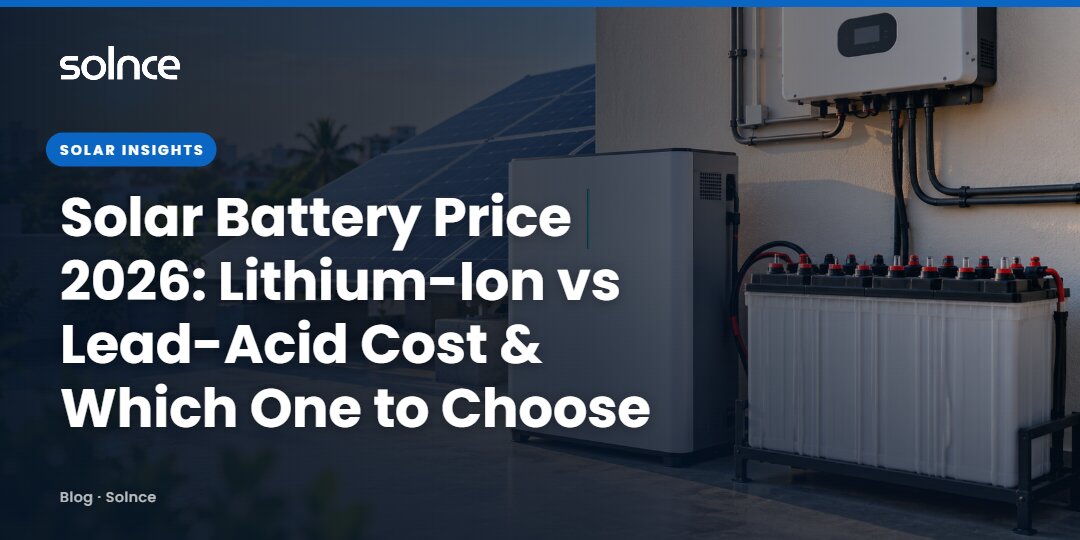
Solar Battery Price in India 2026: Lithium-Ion vs Lead-Acid Cost Comparison
Last updated at : Sep 18, 2026
If you are pricing a rooftop system, the solar battery cost is usually the number that makes you pause. Panels have become cheap. Batteries have not. A battery bank can easily add 40% to 80% to the price of a home solar system, and it is the one part you may have to buy again in four years.
This guide gives you the September 2026 numbers. You will get price tables for lead-acid tubular batteries and lithium (LFP) batteries, both by Ah and by kWh. You will get a sizing method with a worked example, a ten-year total cost comparison that counts replacements, and 2026 prices for the solar battery inverter that sits between the two.
We will also answer the question most articles skip: whether you need a battery at all. For a large share of Indian homes with a decent grid supply, the honest answer is no.
Quick Answer
In September 2026, lead-acid tubular solar batteries cost roughly ₹80 to ₹160 per Ah, which works out to about ₹8,000 to ₹14,000 per kWh installed. Lithium LFP batteries cost roughly ₹400 to ₹750 per Ah, or about ₹18,000 to ₹35,000 per kWh installed. Lithium is two to three times dearer upfront, but lasts three to four times longer and gives you far more usable energy per kWh bought. Over ten years, lithium usually costs less.
Do You Actually Need a Solar Battery?
This is the first question, and it decides everything else. There are three ways to connect rooftop solar in India.
On-grid (grid-tied). Your panels feed the house, and surplus goes to the grid through a net meter. A net meter is simply the meter that counts the units you export and sets them off against the units you import. There is no battery. When the grid fails, the system shuts down for safety, so you get no backup. This is the cheapest option and by far the most common.
Off-grid. No grid connection at all. Everything runs through a battery bank. This makes sense for farms, remote sites, telecom towers and villages with no reliable line. It is expensive and needs generous sizing.
Hybrid. Grid connection plus a battery. You still export surplus where the DISCOM allows it, and you keep a reserve for outages. This costs the most because you pay for both a bigger inverter and the storage.
Here is the part vendors rarely say out loud. A battery does not lower your electricity bill in a net-metered home. Net metering already banks your surplus units on the grid at close to full value. Adding a battery only changes where those units are stored, and you lose 10% to 20% of them to charging and discharging losses along the way.
So a battery is a backup product, not a savings product. If your locality in Surat, Bengaluru or Pune sees two or three short cuts a month, a battery is a comfort purchase, and there is nothing wrong with that as long as you know it will not pay for itself. If you are in a part of Bihar, Jharkhand, Uttar Pradesh or rural Rajasthan where four to eight hour cuts are normal, or you run a clinic, a shop with cold storage, or work from home on video calls, the case is strong.
One more point on money. Under PM Surya Ghar: Muft Bijli Yojana, the residential subsidy is ₹30,000 for 1 kW, ₹60,000 for 2 kW and ₹78,000 for 3 kW and above. That subsidy is calculated on the solar capacity you install, not on storage. Batteries are allowed in a subsidised system but they are not funded by it. Talk of a “PM Surya Ghar 2.0” with storage support has been circulating through 2026, but as of September 2026 nothing has been notified. Plan on paying for the battery yourself.
How Battery Sizing Actually Works
Vendors often size a battery off your panel wattage. That is wrong. Size it off the load you want to back up and for how long.
The working formula is:
Battery size (kWh) = (Backup load in kW × Backup hours) ÷ (Depth of discharge × Inverter efficiency)
Two terms need defining.
Depth of discharge (DoD) is how much of the battery you are allowed to actually use before you damage it. Lead-acid tubular batteries should not be taken below about 50%. Lithium LFP handles 80% to 90% routinely. So a 2.4 kWh lead-acid battery gives you about 1.2 kWh of real energy; a 2.56 kWh LFP battery gives you about 2.3 kWh.
Inverter efficiency is the loss in converting DC from the battery to AC for your appliances. Budget 85% for older lead-acid PCUs and 90% to 93% for a modern hybrid inverter.
Worked Example: A 3 BHK Flat in Ahmedabad
Suppose you want to run the essentials during a cut:
| Appliance | Watts | Qty | Total |
|---|---|---|---|
| Ceiling fan | 75 W | 2 | 150 W |
| LED lights | 9 W | 6 | 54 W |
| Refrigerator (average draw) | 150 W | 1 | 150 W |
| TV | 100 W | 1 | 100 W |
| Wi-Fi router, chargers | 15 W | — | 15 W |
| Total | ≈ 470 W |
Round that to 0.5 kW. You want 4 hours of backup, so you need 2 kWh delivered to the sockets.
Lead-acid route: 2 ÷ 0.50 (DoD) ÷ 0.85 (efficiency) = 4.7 kWh of nominal capacity. A 200Ah, 12V tubular battery holds 2.4 kWh, so you need two of them, in a 24V bank. Battery cost at 2026 rates: roughly ₹32,000 to ₹48,000.
Lithium route: 2 ÷ 0.90 ÷ 0.92 = 2.42 kWh of nominal capacity. A single 2.56 kWh LFP unit does the job. Battery cost: roughly ₹55,000 to ₹70,000.
Notice what happened. The lithium pack is half the rated size and still delivers the same backup, because you can use nearly all of it. That is why comparing batteries on Ah or on sticker price alone is misleading.
Add a safety margin of 20% if the fridge compressor and a water pump might start together, and check the inverter’s surge rating separately.
Lead-Acid Tubular Solar Battery Price in India, 2026
Tubular lead-acid remains the default in most Indian homes because the upfront number is small. These are flooded batteries: you top up distilled water every three to six months, and they need a ventilated space.
| Capacity (12V) | Nominal kWh | Usable kWh (50% DoD) | Price (Sept 2026) | ₹ per kWh nominal | Typical backup at 500 W | Warranty |
|---|---|---|---|---|---|---|
| 100 Ah | 1.2 kWh | 0.6 kWh | ₹8,000 – ₹11,000 | ₹6,700 – ₹9,200 | 2 – 3 hr | 2 – 3 yr |
| 150 Ah | 1.8 kWh | 0.9 kWh | ₹12,000 – ₹18,000 | ₹6,700 – ₹10,000 | 4 – 5 hr | 3 – 5 yr |
| 200 Ah | 2.4 kWh | 1.2 kWh | ₹16,000 – ₹24,000 | ₹6,700 – ₹10,000 | 6 – 8 hr | 3 – 5 yr |
| 250 Ah | 3.0 kWh | 1.5 kWh | ₹22,000 – ₹32,000 | ₹7,300 – ₹10,700 | 8 – 10 hr | 3 – 5 yr |
That is ₹80 to ₹160 per Ah. Prices differ by brand and city. Exide, Amaron, Luminous, Livguard, Okaya and UTL are the volume names, and a well-known brand typically sits ₹1,000 to ₹3,000 above a local one for the same Ah. Once you add the battery trolley, interconnecting cables and installation, budget ₹8,000 to ₹14,000 per kWh installed.
Cycle life is 500 to 800 cycles. Read that in plain terms: if you have a daily power cut and the battery discharges once a day, 600 cycles is under two years of hard use. In a home with occasional cuts, the same battery may last four or five years because it mostly sits on float charge.
Lithium-Ion (LFP) Solar Battery Price in India, 2026
Almost every lithium ion solar battery sold for Indian homes is LFP, short for lithium iron phosphate (LiFePO4). It is the safest common lithium chemistry, tolerates heat better than the NMC cells used in laptops and EVs, and has no cobalt.
A warning before the table: Ah means nothing for lithium unless you know the voltage. A “100Ah lithium battery” can be 1.28 kWh at 12.8V or 5.12 kWh at 51.2V. Always ask for kWh.
| Capacity | kWh at 12.8V | kWh at 51.2V | Price (Sept 2026) | Warranty |
|---|---|---|---|---|
| 50 Ah | 0.64 kWh | 2.56 kWh | ₹20,000 – ₹35,000 | 5 yr |
| 100 Ah | 1.28 kWh | 5.12 kWh | ₹40,000 – ₹70,000 | 5 yr |
| 150 Ah | 1.92 kWh | 7.68 kWh | ₹55,000 – ₹90,000 | 5 – 8 yr |
| 200 Ah | 2.56 kWh | 10.24 kWh | ₹75,000 – ₹1,20,000 | 5 – 8 yr |
That is roughly ₹400 to ₹750 per Ah. Priced the sensible way, by energy:
| Pack size | Typical price (Sept 2026) | ₹ per kWh | Suits |
|---|---|---|---|
| 1.28 kWh | ₹32,000 – ₹40,000 | ₹25,000 – ₹31,000 | Lights, fans, router |
| 2.56 kWh | ₹55,000 – ₹70,000 | ₹21,500 – ₹27,000 | Essentials, 1 BHK / 2 BHK |
| 5 – 5.12 kWh | ₹99,000 – ₹1,20,000 | ₹19,500 – ₹23,500 | Whole-home essentials, small shop |
| 10 – 10.24 kWh | ₹1,90,000 – ₹2,50,000 | ₹18,500 – ₹24,000 | Large home, AC on backup |
| 15 kWh and above | ₹2,80,000 upwards | ₹18,000 – ₹26,000 | Villas, small commercial |
Per-kWh pricing improves as the pack gets bigger, which is why 5 kWh has become the sweet spot for Indian homes. Wall-mounted 5 kWh units from Loom Solar, Livguard, Luminous, Waaree and Exide dominate this bracket, alongside imported packs from Pylontech, Deye and Dyness. A representative 2026 product, the 5.12 kWh wall-mount LFP unit Loom Solar launched in July 2026, is rated 51.2V / 100 Ah, 6,000 cycles at 80% DoD, and works from –20°C to 65°C.
Note on tax: Solar modules and renewable energy devices moved to 5% GST from 22 September 2025, but batteries are classified separately under HSN 8507 and generally attract 18% GST, whether lead-acid or lithium. Treatment inside a composite EPC contract can differ, so ask your installer to show the GST split on the quotation.
The Real Cost Over 10 Years
The upfront price is the wrong comparison. Use the same worked example above, the one that needs about 2.3 kWh of usable energy, and run it out over a decade.
| Comparison Factor | Lead-acid Tubular (2 × 200Ah, 12V) | Lithium LFP (2.56 kWh, 51.2V) |
|---|---|---|
| Nominal capacity bought | 4.8 kWh | 2.56 kWh |
| Usable energy per cycle | ~2.4 kWh (50% DoD) | ~2.3 kWh (90% DoD) |
| Upfront battery cost | ₹32,000 – ₹48,000 | ₹55,000 – ₹70,000 |
| Rated cycle life | 500 – 800 | 3,000 – 6,000 |
| Realistic service life | 3 – 5 years | 8 – 15 years |
| Replacements needed in 10 years | 2 (so 3 sets bought) | 0 |
| Total battery spend, 10 years | ₹96,000 – ₹1,44,000 | ₹55,000 – ₹70,000 |
| Water top-up and maintenance | ₹500 – ₹1,500 a year | Nil |
| Round-trip efficiency | 75% – 85% | 92% – 96% |
| Indicative 10-year cost | ₹1,01,000 – ₹1,59,000 | ₹55,000 – ₹70,000 |
Two honest caveats. First, this assumes battery prices stay flat, which they will not: lithium is getting cheaper, so a replacement in 2036 should cost less than today. Second, dead lead-acid batteries have scrap buy-back value and your dealer will usually knock something off the replacement price. Ask for that number in writing, because it varies a lot by city and by lead price.
Even after those adjustments, the direction does not change. If the battery will cycle most days, lithium wins on ten-year cost. If the battery will sit idle for months at a time and you only need occasional short backup, cheap lead-acid can still be the rational choice, because you are paying mainly for capacity you rarely use.
Depth of Discharge, Cycle Life and Efficiency, Explained Simply
Depth of discharge was covered above, but there is a second-order effect. Lead-acid cycle life collapses when you discharge deeply. Take a tubular battery to 80% depth regularly and 700 rated cycles can become 300 real ones. LFP is much flatter: its cycle rating is usually quoted at 80% DoD already.
Round-trip efficiency is the share of energy that survives the trip in and out of the battery. Lead-acid returns about 75% to 85%. LFP returns 92% to 96%. On a 2 kWh cycle every day, that difference is roughly 100 to 150 units a year quietly lost.
Charge acceptance matters for solar specifically. Lead-acid will not accept a fast charge; the last 20% has to trickle in over hours. If your cut is in the evening and the next cloudy morning gives you only three good sun hours, a lead-acid bank may not be full again by the next evening. LFP takes a much higher charge current and a 5 kWh pack can refill in two to three hours.
Temperature is the Indian variable that gets ignored. Lead-acid life falls sharply above about 30°C, and a Nagpur or Jaipur battery room at 45°C in May will not deliver the rated years. LFP is more tolerant, typically rated to 55°C or 60°C for discharge, though charging below 0°C needs a BMS with a heater in Leh or Shimla type conditions.
Space and ventilation. A 4.8 kWh lead-acid bank is two batteries of 55 to 65 kg each on a trolley, needing an open, ventilated spot because flooded cells vent hydrogen. Never put them in a sealed cupboard or a bedroom. A 5 kWh LFP unit is a sealed 45 to 50 kg box that mounts on a wall in a utility area, takes about 2 sq ft of wall, and vents nothing.
Solar Battery Inverter Price in India, 2026
The battery needs an inverter that can charge it from solar and run your loads. Two names you will hear:
- PCU (Power Conditioning Unit): An off-grid unit with a solar charge controller built in. It runs loads from panels and battery, uses the grid only as a fallback charger, and cannot export.
- Hybrid inverter: Does everything a PCU does, plus it can synchronise with the grid and export surplus under net metering.
If you have or want net metering, buy a hybrid. The solar battery inverter price in September 2026:
| Rating | Budget Brands | Mid-Market | Premium |
|---|---|---|---|
| 3 kW hybrid | ₹38,000 – ₹48,000 | ₹45,000 – ₹58,000 | ₹55,000 – ₹65,000 |
| 5 kW hybrid | ₹48,000 – ₹58,000 | ₹55,000 – ₹85,000 | ₹75,000 – ₹90,000 |
| 8 kW hybrid | ₹70,000 – ₹85,000 | ₹85,000 – ₹1,10,000 | ₹1,10,000 – ₹1,30,000 |
| 10 kW hybrid | ₹80,000 – ₹95,000 | ₹95,000 – ₹1,30,000 | ₹1,30,000 – ₹1,60,000 |
UTL and Microtek sit at the budget end; Deye, Growatt and Luminous in the middle; Sungrow and GoodWe at the top. Smaller 1 kW to 2 kW off-grid PCUs are widely sold below the 3 kW band, but prices there vary sharply, so insist on a written quote with the model number.
As a rule of thumb, choosing hybrid over a plain on-grid inverter adds about ₹20,000 to ₹40,000 to the system before you have bought a single battery. Two things to check on the datasheet:
- The inverter supports the battery voltage you plan to buy. A 48V/51.2V lithium battery will not work with a 24V-only PCU.
- The inverter communicates with the battery's BMS through CAN or RS-485.
Without that communication link, the inverter guesses at state of charge and you get nuisance shutdowns.
The 200Ah Solar Battery, Specifically
The 200Ah solar battery price is one of the most searched numbers in Indian solar, so it deserves its own note.
A 200Ah 12V tubular battery costs ₹16,000 to ₹24,000 in September 2026 and stores 2.4 kWh, of which about 1.2 kWh is safely usable. On a 500 W load that is roughly six to eight hours; on a 1,000 W load, closer to three. Most homes buy two of these to make a 24V bank, because a single 12V battery limits how much load the inverter can take.
A 200Ah lithium battery is a completely different animal depending on voltage. At 12.8V it is 2.56 kWh and costs around ₹75,000 to ₹95,000. At 51.2V it is 10.24 kWh and costs ₹1,90,000 or more. If a quotation just says “200Ah lithium”, send it back and ask for volts and kWh.
For a like-for-like comparison at the same usable energy, one 2.56 kWh LFP unit replaces two 200Ah tubular batteries and takes up a fraction of the floor space.
Warranty, Standards, Safety and Disposal
Warranty: Read what is being promised. Lead-acid warranties are often split, for example “36 months full plus 24 months pro-rata”, where the second half only gives you a partial credit. Lithium warranties are usually stated in years and cycles and an end-of-life capacity, such as “10 years or 6,000 cycles, whichever comes first, to 70% of rated capacity”. A warranty with no cycle number and no capacity retention figure is weak. Also confirm whether it is an on-site replacement or a carry-in claim, because a 50 kg battery is not something you want to transport.
Standards: Lithium-ion cells and battery packs sold in India need BIS registration under the Compulsory Registration Scheme, tested to IS 16046 (aligned with IEC 62133). Larger stationary systems are commonly tested to IEC 62619. Ask for the BIS registration number, and be wary of unbranded imported packs sold on marketplaces. There is no ALMM-style approved list for batteries the way there is for solar modules, though the Ministry of Power did introduce a 20% domestic content requirement in December 2025 for grid-scale battery projects claiming viability gap funding. That rule applies to utility projects, not to your rooftop.
Safety: LFP does not go into thermal runaway as readily as NMC, but the pack still needs a working BMS, correct DC fusing and an isolator. Keep the installation away from bedrooms and out of direct sun. For lead-acid, ventilation is the safety issue, not fire.
Disposal: Under the Battery Waste Management Rules, 2022, sending batteries to landfill or incinerating them is prohibited. Producers carry Extended Producer Responsibility, meaning the brand is obliged to collect and recycle what it sells, with minimum material recovery targets and mandated recycled content in new batteries. In practice, hand your dead battery back to the dealer or an authorised collection point and take the buy-back. Selling it to a roadside scrap dealer feeds informal lead smelting, which is both illegal and genuinely dangerous to the people who do it.
2026 Update: Where Prices Are Heading
Storage costs are falling faster than most people realise. BloombergNEF’s December 2025 survey put the global average turnkey battery system price at US$117/kWh, down 31% in a single year, with lithium-ion pack prices averaging US$108/kWh and stationary storage packs at about US$70/kWh. Indian retail prices lag global cell prices by a year or more because of import duty, GST, freight and dealer margin, but the direction is clear: LFP retail has drifted from roughly ₹30,000 per kWh a couple of years ago to ₹18,000 to ₹25,000 per kWh for larger packs today.
Sodium-ion is the technology to watch. Naxion Energy announced India’s first sodium-ion residential and C&I storage systems in December 2025, built in Coimbatore in 3.5 kW, 5 kW and 10 kW models, with an operating range of –30°C to +70°C and a stated plan for domestic cell manufacturing by 2027. CATL also unveiled a new sodium-ion product in April 2026. Sodium-ion uses no lithium and no cobalt, which suits India’s import position, and it handles heat well. It is not yet cheaper than LFP at retail in India, and volumes are small. Do not delay a purchase waiting for it, but do expect real options by 2027 or 2028.
The practical takeaway: if you need backup now, buy now and size it tightly. If you are only “future-proofing”, wait. A hybrid inverter installed today lets you add batteries later, which is usually the smarter sequencing.
Common Mistakes to Avoid
- Buying a battery to cut your bill. In a net-metered home it does not. It shifts energy and loses some of it.
- Sizing from panel wattage. Size from the load you back up and the hours you need.
- Comparing lead-acid and lithium on rated Ah. Compare usable kWh after depth of discharge.
- Ignoring the inverter. A cheap PCU that cannot talk to a lithium BMS will make an expensive battery behave badly.
- Backing up the air conditioner “just in case”. An AC on backup can triple your battery budget. Back up essentials, and run the AC when the grid is on.
- Putting flooded lead-acid in a closed cupboard. It needs ventilation.
- Accepting a verbal warranty. Get years, cycles and capacity retention on the invoice.
- Not asking about the DISCOM. Some state DISCOMs have conditions on battery-backed systems under net metering. Confirm before you order.
Frequently Asked Questions
Q1. Do I need a battery with my rooftop solar system?
Only if you want backup during power cuts. In a net-metered on-grid system, the grid already acts as your storage and gives you credit for exported units at close to full value. A battery adds cost and loses 10% to 20% of the energy passing through it. Add one if outages genuinely disrupt your home or business, not to reduce your bill.
Q2. What is the solar battery cost per kWh in India in 2026?
Lead-acid tubular works out to roughly ₹8,000 to ₹14,000 per kWh installed. Lithium LFP is roughly ₹18,000 to ₹35,000 per kWh installed, with larger packs at the cheaper end of that range. Remember that lead-acid only lets you use about half of what you buy, so the cost per usable kWh is much closer than it first appears.
Q3. What is the 200Ah solar battery price right now?
A 200Ah 12V lead-acid tubular battery costs ₹16,000 to ₹24,000 in September 2026, storing 2.4 kWh with about 1.2 kWh usable. A 200Ah lithium battery costs ₹75,000 to ₹1,20,000, but the capacity depends entirely on voltage: 2.56 kWh at 12.8V, or 10.24 kWh at 51.2V. Always ask for the kWh figure.
Q4. How long does a solar battery last?
Lead-acid tubular typically lasts three to five years, or 500 to 800 cycles. Lithium LFP typically lasts eight to fifteen years, or 3,000 to 6,000 cycles. Actual life depends heavily on how deeply you discharge it, how hot the location gets, and whether it is kept properly charged. Daily deep cycling shortens lead-acid life dramatically.
Q5. Is lithium worth the extra money?
If the battery will cycle most days, yes. Over ten years a lithium pack usually costs less in total because you avoid two replacements and the maintenance. If your battery will sit unused for months and only serve rare short cuts, lead-acid can still be the cheaper practical choice for the whole period.
Q6. Does PM Surya Ghar subsidy cover batteries?
No. The subsidy of ₹30,000 for 1 kW, ₹60,000 for 2 kW and ₹78,000 for 3 kW and above is calculated on the solar capacity installed, not on storage. You can add a battery to a subsidised system, but you pay for it entirely yourself. Proposals for battery support under a possible scheme revision have been discussed through 2026 but nothing has been notified.
Q7. What is depth of discharge and why does it matter?
It is the share of a battery’s rated capacity you can safely use. Lead-acid should not go below about 50%, so a 2.4 kWh battery gives you 1.2 kWh. Lithium LFP handles 80% to 90%, so a 2.56 kWh pack gives about 2.3 kWh. It is the single biggest reason rated capacity is a misleading comparison.
Q8. How do I calculate what size battery I need?
Add up the wattage of what you want to back up, multiply by the hours of backup you need to get kWh delivered, then divide by depth of discharge and by inverter efficiency. For 500 W over 4 hours you need 2 kWh delivered, which means about 4.7 kWh of lead-acid or about 2.4 kWh of lithium. Add 20% margin for motor starting loads.
Q9. What does a solar battery inverter cost in 2026?
Hybrid inverters run about ₹38,000 to ₹65,000 for 3 kW, ₹48,000 to ₹90,000 for 5 kW, ₹70,000 to ₹1,30,000 for 8 kW and ₹80,000 to ₹1,60,000 for 10 kW, depending on brand tier. Choosing hybrid instead of a plain on-grid inverter typically adds ₹20,000 to ₹40,000 before any battery cost.
Q10. What is the difference between a PCU and a hybrid inverter?
A PCU is an off-grid unit with a built-in solar charge controller. It runs loads from solar and battery and uses the grid only to charge, but it cannot export. A hybrid inverter does all of that and also synchronises with the grid so you can export surplus under net metering. If you want net metering, buy a hybrid.
Q11. Can I add a battery to my existing on-grid solar system later?
Usually yes, but it depends on the inverter. A plain on-grid string inverter cannot charge a battery, so you would need to replace it with a hybrid or add a separate AC-coupled battery inverter. If you think you may want storage in a few years, buying a hybrid inverter at the outset is the cheaper path.
Q12. How much space and ventilation does a battery need?
A 4.8 kWh lead-acid bank is two batteries weighing 55 to 65 kg each on a trolley, and flooded cells vent hydrogen, so they need an open, ventilated area, never a sealed cupboard or bedroom. A 5 kWh lithium unit is a sealed wall-mounted box of about 45 to 50 kg taking roughly 2 sq ft of wall, with no venting.
Q13. Do Indian summers damage solar batteries?
Heat is the main enemy of lead-acid. Life falls sharply above about 30°C, so a battery room hitting 45°C in a Jaipur or Nagpur May will not deliver its rated years. Lithium LFP is more tolerant, commonly rated for discharge up to 55°C or 60°C. In both cases, keep the battery shaded, off hot walls and reasonably ventilated.
Q14. What GST applies to solar batteries?
Solar modules and renewable energy devices moved to 5% GST from 22 September 2025, but batteries fall under HSN 8507 and generally attract 18%, whether lead-acid or lithium. Treatment can differ when the battery is supplied inside a composite EPC contract, so ask your installer to show the GST breakup line by line on the quotation.
Q15. Are lithium solar batteries safe?
LFP is the safest common lithium chemistry and does not enter thermal runaway as readily as the NMC cells used in phones and EVs. Safety still depends on a working battery management system, correct DC fusing and an isolator. Buy packs with BIS registration under IS 16046, and avoid unbranded imported packs sold cheaply on marketplaces.
Q16. What should I do with an old solar battery?
Under the Battery Waste Management Rules, 2022, landfilling and incineration are banned and producers carry Extended Producer Responsibility for collecting and recycling what they sell. Return the battery to your dealer or an authorised collection point and take the buy-back credit. Do not sell it to a roadside scrap dealer, which feeds unsafe informal lead smelting.
Q17. Will battery prices fall further?
Very likely. BloombergNEF’s December 2025 survey found global turnkey storage system prices had fallen 31% in a year to about US$117/kWh, with pack prices around US$108/kWh. Indian retail lags global cell prices by a year or more, but LFP has already drifted down toward ₹18,000 to ₹25,000 per kWh for larger packs. Expect gradual, not dramatic, further decline.
Q18. Should I wait for sodium-ion batteries?
Not if you need backup now. Naxion Energy launched India’s first sodium-ion residential and C&I systems in December 2025 from a Coimbatore plant, and CATL showed a new sodium-ion product in April 2026. The chemistry avoids lithium and cobalt and handles heat well, but it is not yet cheaper than LFP at Indian retail and volumes are small. Realistic mainstream options are more likely in 2027 or 2028.
Q19. How many batteries do I need for a 3 kW solar system?
There is no fixed answer, because battery count follows your backup load, not your panel size. A 3 kW system with essential loads backed up for four hours typically pairs with about 2.5 to 3 kWh of lithium, or two 200Ah tubular batteries. If you want to back up a refrigerator plus more circuits overnight, plan on 5 kWh of lithium.
Q20. What warranty terms should I insist on?
For lithium, get years, cycle count and end-of-life capacity retention in writing, for example “10 years or 6,000 cycles to 70% capacity”. For lead-acid, check how much of the stated warranty is full replacement and how much is pro-rata credit. In both cases confirm whether the claim is on-site or carry-in, since these are heavy units.
Talk to a Solnce Expert
Solnce Energy has installed over 100 MW of solar across India for more than 1,500 customers, covering rooftop, C&I, solar parks and PPAs. We are based in Surat, Gujarat, and were backed on Shark Tank India Season 4. If you are unsure whether your home actually needs storage, or what size to buy, our team will size it against your real load and give you a written quote with the GST and warranty terms spelled out.